Friday, March 30, 2007

educating for delight and responsibility

BBC Radio 4 has on its website for the next few days a charming and inspiring little (about half an hour) conversation between author Philip Pullman and Enid Jones who was his secondary school teacher in Wales almost 50 years ago. Pullman is the author of many books, including the intricately imaginative trilogy His Dark Materials (The Golden Compass -- called The Northern Lights in some editions -- The Subtle Knife, and the Amber Spyglass). His Dark Materials is often what comes to my mind when I'm asked what is my favorite book (even though it is three books!). My family was lucky to discover the set only after the third one was published, so that we didn' t have to wait for years between books like earlier fans did. Now the books are being made into a film (you can read more about that in Pullman's own words here)

Pullman has stayed in touch with Miss Jones over the years, and in their conversation they touch on what the radio show host describes as "trying to trace the impossible -- the sources of his inspiration" -- education as a practice of "delight and responsibility," Pullman's own early teaching career as "a wonderful apprenticeship in storytelling," writing as "a process of discovery" and that if you have a plan and an outline (as writing instructors in our schools these days tend to insist) "in advance you won't discover anything."

But it looks like the shows only stay available till the next week's show gets posted, so best to go hear it now! (it's on the right, under "Listen Again" for Thursday)

Tuesday, March 20, 2007

voices, songs

Sometimes there is too much to say, and all the ideas and words get piled up at the door -- so to free up the flow a bit, here are some as gleaming links, each deserving to be looked at close-up and in detail. (Update: and here is a much better clip of the amazing Discovery Channel program mentioned below -- this one a clip of a awesomely massive great white shark hurling its whole body out of the water to engulf a seal.)

My friend Karen described to me the other day what it felt like in the woods where she used to live, hearing the watery warbling songs of a type of thrush, each calling across the forest to the others, so that you could feel by the songs how deep the place was.

Here are some beautiful voices that are helping me feel how deep this place is:

Recovering Whole Mind:
Jeff Aitken is posting rich excerpts from his doctoral dissertation on indigenous traditional knowledge and Open Space:
"My center of gravity has shifted. I feel that I am in the land, not on the land. These trees outside my window are my relatives, older relatives (chayyah, “sprouting beings”), who came here before my kind, and made it possible for my kind (m'dahber, “the talking beings”) to come forth, nurturing us with life giving breath (ruach), with fruits and nuts (pri ha'etz), with wood and leaves to build structures for warmth and comfort."
The One Voice Movement was invited to the World Economic Forum in Davos this year to deliver their message: "Our destinies will no longer be ruled by extremists. We - Israelis, Palestinians and international supporters - will work ceaselessly to support our elected leaders in their efforts to end the conflict. We will stand up as OneVoice for conflict resolution and non-violent citizen action" via powerful videos of passionate voices in several languages.

Avaaz ("voice" or "song" in
Hindi, Urdu, Farsi, Nepalese, Dari, Turkish, and Bosnian) "is a community of global citizens who take action on the major issues facing the world today. The aim of Avaaz.org is to ensure that the views and values of the world’s people shape global decisions. Avaaz.org members act for a more just and peaceful world and a globalisation with a human face." Their video, "Stop the Clash of Civilizations" is here.

The New Wilderness Project:
"Through performances, workshops, and educational expeditions, New Wilderness Project is an exploration of wilderness and all of its social, cultural, artistic, and environmental implications. Our programs are designed to break down traditional barriers and create an open space where participants are encouraged to take a journey of discovery into difference, and otherness, toward the vital relationships that define social and ecological well-being."

KarmaTube, which is part of CharityFocus ("an experiment in the joy of giving"),
"is a collection of short, "do something" videos coupled with simple actions that every viewer can take. Our mission is to spread the good. Thank you for your partnership in service."

Last link for today is to the stunning images in the Discovery Channel program "Planet Earth." The official website is fancy but pages seem to take a long time to load. Video clips of some of the most spectacular shots are easier to view on the Nature Conservancy site (and unlike the above video clips, I prefer to watch these ones without the voice-over track switched on!)

Wednesday, March 14, 2007

time and perfection

Oh, dear, I got out of the blogging saddle for a little while, and now I think I've forgotten how!

Hmm. So. Well, the past couple of weeks have been plushly full. On Friday I had the privilege and deep pleasure of filling in with what thoughts I was able to gather together, for my friend Bill who was teaching Advanced Naturopathic Therapeutics to the senior naturopathic medical students before he passed away. The students are so generous and receptive, and were willing to thoughtfully and heartfully engage with all of the ideas I scattered before them. I am very appreciative of their powerful collective presence and imagination.

One of the things I spoke with them about was our relationship with time, as human beings and particularly as clinicians (if you visit this link, scroll down to #4, Dr. Bob May's comments). One of the aspects that characterizes holistic care is the amount of time we dedicate to cultivating relationships, to listening and perceiving and exploring.

Bill taught us an expanded understanding of time and perfection and our place in the scheme. He wrote in his chapter on The Healing Power of Nature, for the forthcoming Foundations of Naturopathic Medicine textbook,
…the possibility for higher wellness predates the effort or even the awareness, but exists as an attractive force because the healing power of nature has more wisdom than the sentient present tense of the person.

“In this sense, we are attracted to a higher level of wellness by the future.
” Bill Mitchell, the Vis Medicatrix Naturae, pg. 8.
Another view on time that I've been carrying close in the past couple of weeks comes from No End, No Beginning: The Intimate Heart of Zen, by Jakusho Kwong Roshi:
"...the first teacher you will meet at a Zen center is the schedule. No matter what you may want to do or not do, the schedule provides a kind of natural pressure that pushes you past your hindrances, past your ideas of yourself and your fears or inhibitions...All of this pressure begins to accumulate like frost gathering on snow; it functions like the pressure that transforms coal into diamond."
Being so busy lately has me feeling very acutely the edges of my schedule; Kwong Roshi's view gives me a new appreciation for those edges. Regarding it as my teacher I am even starting to show up on time (most of the time!)

Friday, February 23, 2007

meeting space

We are just back from a few days visiting family in northern California, where I grew up and where my mom still lives.

If you peer very closely at this view of the Marin headlands, facing south towards San Francisco, you really can see the top of the Golden Gate bridge peeking up in the dip between the hills. One of the trailheads up to the headlands, part of the Golden Gate National Recreation area, begins just up the hill next to my elementary school (well, from the school you wind your way up the hill through a development of multi-million-dollar homes, then you get to the trail)


A special treat on Thursday was getting to meet with Jeff Aitken face to face for the first time, after a long while of being words-on-a-screen friends through the Open Space world community, and its warm loose confluence of bloggers connected in heart and soul if not in time and space.

Here we are at Caffee Puccini, one of Jeff's neighborhood favorites where we told stories and laughed and drank coffee with an opera soundtrack for a background.


Looking west from the trail, you are met by this view of the Pacific ocean.

Friday, February 16, 2007

real work

"I do like my work," she said to her friends over coffee and chocolate biscotti. "When I'm in my practice, I'm engaged, and doing good work, and people seem to be benefiting. But, when I'm not in the office, I think of my real work work as this," she said. She waved her arms vaguely.

"What is "this"?" her friends asked kindly.

"This -- the medicine of hanging out together," she said.

"Ooooo. That's good," said her friends.

Saturday, February 03, 2007

fonting

Well, switching over to the "new" Blogger, I find that the font size I used to use is WAY too small in this version, so even though I am planning to finally get reading glasses any second now, I think I will gradually edit my archives. Plus, I get to label and categorize now, which is satisfying! Apologies in advance to my friends who are tracking me via subscription feed, for the potential cramming up with the updates.

Just a little ice, and some things starting to bud:

songs of ascent

As I sit down to begin this post, it is not quite sunset. So it is still, just barely, the 15th of Shevat -- Tu B'shvat -- which is the date of a Jewish holiday called the New Year for Trees. Being a lunar calendar, the beginning of the month is always the new moon, and the 15th is the full moon. The full moon this month marks a traditionally minor agricultural festival whose esoteric meaning is not minor at all: it is the day in the very dead of winter when the Tree of Life begins to reawaken. In modern times it has become a popular time for tree-planting and remembering the importance of wise ecological stewardship and for celebration of the wood beings.

Psalms 120-134 are known as the "songs of ascent," (shirot ha'maalot) and are traditionally chanted on Tu B'shvat, or on the fifteen days between the beginning and middle of the month. Rabbi Jill Hammer teaches that the ascending nature of this practice echoes the rising of the sap in the trees at this time of year (in the mid-east countries, anyway!) It's also thought that these 15 songs of praise might have been sung by pilgrims ascending the great steps up to the massive Temple in Jerusalem.

Last night, with a misty full moon glowing through the floor-to-ceiling windows of Bastyr's darkened cafeteria, the student-organized Mystery School hosted a circle gathering in memory and mourning and celebration of their beloved mentor and professor, Dr. Bill Mitchell. Circle participants were asked to bring something that reminded them of Bill, for a small altar set up in the center of the room. Bill's long-time companion Joanie brought Bill's amazing beaded
wooden rattle, the top made of a twisted tree branch that looked vaguely like the skull of a goat, and which we got to use as a talking stick. Many people brought special plants and poems and music, and everyone had a story. Just as during his memorial service, the abundant stories last night revealed again and again Bill's extraordinary capacity for infusing all of his relationships and even brief encounters with presence and kindness and joy. How amazing it is to realize that every one of us who considered ourselves his friend is correctly certain that our relationship with him was a particularly treasured, and intimate, and loving connection -- and I think that, without exaggeration, "us" equals thousands of people -- family and friends, patients and colleagues and especially current students.

For the circle, I brought one of those songs of ascent, Psalm 121, as translated/interpreted by Stephen Mitchell.

I look deep into my heart,
to the core where wisdom arises.
Wisdom comes from the Unnamable
and unifies heaven and earth.
The Unnamable is always with you,
shining from the depths of your heart.
His peace will keep you untroubled
even in the greatest pain.
When you find him present within you,
you find truth at every moment.
He will guard you from all wrongdoing;
he will guide your feet on his path.
He will temper your youth with patience;
he will crown your old age with fulfillment.
And dying, you will leave your body
as effortlessly as a sigh.

(This illluminated text is a fragment of the Psalm by Jerusalem scribe Avraham Borshevsky)

I also brought to the circle the Hebrew words set to music, which I learned from the gorgeous Israeli group Sheva (I can't figure out how to access the direct link, so if you go to their site, choose English, click on Discography, and then on the second CD from the top -- "Day and Night" -- then on the first song, and you can hear a tiny tiny snip)

Their translation for what Stephen Mitchell calls "the Unnamable" is "the Pure Being".

Now, it really is dark, the moon is on the wane, and so it's become the 16th of Shevat.

The Tree of Life continues to surge with the juices of new vitality.

And in our basement office, with its plant-friendly compact fluorescent lights, a descendant of the Tree of the Consciousness is already bearing leaves and fruit (Rabbi Ted like to point out that in the Hebrew version of the Eden story, it does not say "apple," it says "fruit," though afterwards the incarnating beings did sew fig leaves together for clothes...as long as we're pretty sure it couldn't have been a mango, then can't you imagine the luscious fig in that role of the sweet irresistible temptation luring the new humans onto the path of awakening incarnation?)

Sunday, January 28, 2007

one day it cracks them open

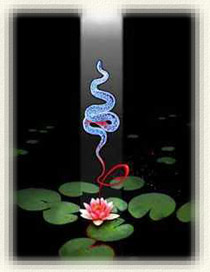
After talking today with a dear friend about his obviously powerful practice of kundalini yoga (a practice that awakens the energy lying like a serpent coiled at the base of spine, which then rises to enable the yogi's individual consciousness to merge with the Divine Consciousness), I remembered that my hero-friend Bill Mitchell practiced and taught a type of kundalini yoga for many years. I have had a sweet strong sense of Bill yesterday and today as a being who has suddenly shifted form, merged with the cosmos, gone super-nova, and become an intense radiance that has lit up the stars in our eyes... and now I recall a lovely comment that Chris wrote at Ashley's when a soul friend of theirs died a month ago at the solstice: "I have had this image with me all day of a star exploding, shedding layers and layers and seeding many new stars all around."

So many new stars.

I think that this star-burst/snake-uncoiling energy is an ecstatic one. An energy that takes us far beyond our ordinary sense of who we are, beyond where we think we end and the rest of the universe begins. A power that we experience at numinous times like these, when the veil floats aside for a moment and we are tossed high and low by the great winds of life and death. When we feel pinned through the heart to this present time; and when there's nothing left of us to be pinned, because we've already been dissolved into the fertile emptiness.

An energy to appreciate, and maybe, like my friends, to cultivate.

"Many myths...speak of a snake that glides, sinuous and silent, through the shimmering branches of the body-tree. Universally, the snake symbolizes the primordial creative energy of the cosmos in general and the life force within the body in particular. What we call ecstasy is the dance of the serpent through the tree of our consciousness.
--
"If you think of your body as a house, the serpentine force is the electricity that flows through all the rooms and lights them up. Seen with the inner eye, every living body appears luminous -- it shines, shimmers and scintillates, each cell a little star.
--
"Ecstasy is always a gift of grace. Its comings and goings cannot be controlled...Or, as Rumi puts it, "God's joy moves from unmarked box to unmarked box."
~Jalaja Bonheim, PhD

Unmarked Boxes
Jalal al-din Rumi
translated by Coleman Barks


Don't grieve. Anything you lose comes round
in another form. The child weaned from mother's milk
now drinks wine and honey mixed.

God's joy moves from unmarked box to unmarked box,
from cell to cell. As rainwater, down into flower bed.
As roses, up from ground.
Now it looks like a plate of rice and fish,
now a cliff covered with vines,
now a horse being saddled.
It hides within these,
till one day it cracks them open.

Part of the self leaves the body when we sleep
and changes shape. You might say, "Last night
I was a cypress tree, a small bed of tulips,
a field of grapevines." Then the phantasm goes away.
You're back in the room.
I don't want to make any one fearful.
Hear what's behind what I say.

Tatatumtum tatum tatadum.
There's the light gold of wheat in the sun
and the gold of bread made from that wheat.
I have neither. I'm only talking about them,

as a town in the desert looks up
at stars on a clear night.

Thursday, January 25, 2007

dreaming bill

(Updated 2/15/07: There will be two memorial services for Bill at Bastyr University, one on Friday Feb. 23 at 5:30 pm in the chapel, moving to the fire circle on the hill above the herb garden at 6:30. The second will be the following day, Saturday Feb 24, a formal service in the chapel at 2 pm that will be webcast)

My spirit buddy and teacher, Dr. Bill Mitchell, died the night before last of a broken heart. His son Noah, aged 27, had died suddenly in the morning, and Bill died that night in his sleep. They both died of myocardial infarction ("heart attack").


Bill was one of the co-founders of the John Bastyr College of Naturopathic Medicine, where I went to medical school, which has since grown up to become Bastyr University.

For the first 15 or 16 years that I knew Bill, I really mostly just knew of him, and he didn't really know me. Like many of my school mates, I was in awe of his brilliance, his robust connection to the natural world, and his weirdness -- little realizing how weird I was going to turn out to be myself.

In 2002, when I started a two year stint as Assistant Dean in the Naturopathic Medicine department at Bastyr, one of my first and favorite assignments was to support Bill's teaching of a new elective course, the prototype for a series meant to embody and make explicit the part of Bastyr's mission statement that emphasizes education and services that "integrate mind, body, spirit and nature". I got to talk with him often on the phone and meet with him to create the syllabus and course requirements and other things he was not so interested in. He told me early on that "the syllabus can't really be created until after the course is over, because I won't know till then what Spirit's going to want me to say." Then we laughed for a long time and knew that we understood each other, and ever since then we have loved each other.

I last saw Bill a couple of months ago over lunch at a little restaurant near his office. He talked about an idea of leaving his practice to his daughter, who is also a naturopathic doctor, and maybe leaving this city where he had been for so many years, about going to a place where he could swim for hours in the warm ocean. Our last interaction, though, was by email, which turned out to be a pretty reliable way to keep very loose track of his moonbeam self. I had written him to describe a dream I'd had of him on New Year's Eve, where I had been so happy to run into him because I needed to ask him a question about Dr. Bastyr's practice. In my dream, he'd said, "well, that means Dr. Bastyr has something to tell you!" and pulled a large phone out his jacket, to connect me with Dr. Bastyr (who died in 1995). Then I woke up. Bill's email reply to me was "Wow what a great dream. Dr. Bastyr healed you. You knew you were being healed. He didn't say a lot. And he worked on your back and neck. Love and laughter in the new year. Bill"

Bill had ravishingly hard times in the past few years, enough to break a heart many times over. He was scoured out from the inside and became almost transparent; you could see the light shining straight through him. He let all the hardship pour through him like a great river, and he didn't hide from it or hide it from those of us who orbited him.

It turned out that I often had occasion to weep in Bill's presence, for very varied reasons. He never minded, it was always OK with him. I know that it's OK with him, now, too. Leaning on his presence was like leaning on a mountain. And that's still true, too.

The soundtrack for my day yesterday, before I had heard about Bill, happened to be Joni Mitchell's Blue, and her song "A Case of You" has gotten woven now into the missing him that rises up today:

I remember
that time you told me
you said,
'love is touching souls'
surely
you've touched mine
Part of you
pours out of me
in these lines from time to time

You're in my blood
like holy wine

and from Hildegard von Bingen, one of Bill's patron saints
and about whom he was exceedingly knowledgeable:


I am the one whose praise echoes on high.
I adorn all the earth.
I am the breeze that nurtures all things green.
I encourage blossoms to flourish with ripening fruits.
I am led by the spirit to feed the purest streams.
I am the rain coming from the dew
that causes the grasses to laugh with the joy of life.
I am the yearning for good.

Tuesday, January 23, 2007

happy birthday, rabbi ted!

Yom huledet sameach, Rabbi Ted! Happy 65th birthday, with deep love and appreciation for the way you have been willing to enter the center of the fray all your life in order to offer the teachings of the one silence.

A birthday sort of poem, courtesy of Panhala:


Instructions
Give up the world; give up self; finally, give up God.
Find god in rhododendrons and rocks,
passers-by, your cat.
Pare your beliefs, your absolutes.
Make it simple; make it clean.
No carry-on luggage allowed.
Examine all you have
with a loving and critical eye, then
throw away some more.
Repeat. Repeat.
Keep this and only this:
what your heart beats loudly for
what feels heavy and full in your gut.
There will only be one or two
things you will keep,
and they will fit lightly
in your pocket.

Wednesday, January 17, 2007

that last curving and impossible sliver of light

one of Saturn's moons
photo source

our moon's phase tonight: waning, 1% of full

FAITH
by David Whyte

I want to write about faith,
about the way the moon rises
over cold snow, night after night,

faithful even as it fades from fullness,
slowly becoming that last curving and impossible
sliver of light before the final darkness.

But I have no faith myself
I refuse it the smallest entry.

Let this, then, my small poem,
like a new moon, slender and barely open,
be the first prayer that opens me to faith.

by David Whyte, from *Where Many Rivers Meet*

Tuesday, January 16, 2007

dangerous unselfishness

In a new book by University of Washington, Tacoma, professor Michael Honey, Going Down Jericho Road: The Memphis Strike, Martin Luther King's Last Campaign, one of the 1300 sanitation workers on whose behalf Dr. King was there in Memphis, says of him: "King was like Moses. You can't keep treating people wrong, you gotta do right some time."

It was in Memphis on the eve of his assasination that he gave the prophetic "I've been to the mountaintop" speech, in which he declared, "Let us develop a kind of dangerous unselfishness." He explored the parable of the good Samaritan who helped the man along the road between Jerusalem and Jericho:

"
But I'm going to tell you what my imagination tells me. It's possible that these men were afraid. You see, the Jericho road is a dangerous road. I remember when Mrs. King and I were first in Jerusalem. We rented a car and drove from Jerusalem down to Jericho. And as soon as we got on that road, I said to my wife, "I can see why Jesus used this as a setting for his parable." It's a winding, meandering road. It's really conducive for ambushing. You start out in Jerusalem, which is about 1200 miles, or rather 1200 feet above sea level. And by the time you get down to Jericho, fifteen or twenty minutes later, you're about 2200 feet below sea level. That's a dangerous road. In the day of Jesus it came to be known as the 'Bloody Pass.'

…And so the first question that the Levite asked was, 'If I stop to help this man, what will happen to me?' But then the Good Samaritan came by. And he reversed the question: 'If I do not stop to help this man, what will happen to him?'

That's the question before you tonight. Not, 'If I stop to help the sanitation workers, what will happen to all of the hours that I usually spend in my office every day and every week as a pastor?' The question is not, 'If I stop to help this man in need, what will happen to me?' 'If I do not stop to help the sanitation workers, what will happen to them?' That's the question."

That speech, his last, ends like this:

"…Well, I don't know what will happen now. We've got some difficult days ahead. But it doesn't matter with me now. Because I've been to the mountaintop. And I don't mind. Like anybody, I would like to live a long life. Longevity has its place. But I'm not concerned about that now. I just want to do God's will. And He's allowed me to go up to the mountain. And I've looked over. And I've seen the promised land. I may not get there with you. But I want you to know tonight, that we, as a people will get to the promised land. And I'm happy, tonight. I'm not worried about anything. I'm not fearing any man. Mine eyes have seen the glory of the coming of the Lord."

Though the words are powerful to read (find the complete transcript here), it is immeasurably more powerful to actually hear him, which you can do from here, or hear and see him, which you can do here or here; to feel his deep, slow, deliberate, rhythmic voice, and his message, and his force of spirit, roll through you and carry you and hold you up.

"But Moses never got to the Promised Land, and I just couldn't understand it...Moses only got to see the Promised Land and to watch the others go there. Everyone else had been given their dream. It didn't seem fair to me.
"When I told this to my grandfather, he smiled. 'But Moses did get his dream,' he said. 'Moses was a leader, Neshume-le, and a leader always has a different dream from the others.'
"He reminded me of mitzvot, those human actions that help move things in the direction in which God is trying to move them. When a person does such an action, they become God's hands in the world. 'There are many mitzvot, but the greatest mitzvah of all is said to be the freeing of captives,' he told me. 'Moses's dream was for his people to be free. And so his reward was that he got to see that happen. Because he was a leader, his dream was different from the dreams of the people, Neshume-le.

"A real leader has the same dream that God has.'"

~My Grandfather's Blessings, Rachel Naomi Remen, M.D.

Sunday, January 07, 2007

winter and water

Yesterday I caught a brief, a really really brief, glimpse of the possibility that the light will remember to come back here.

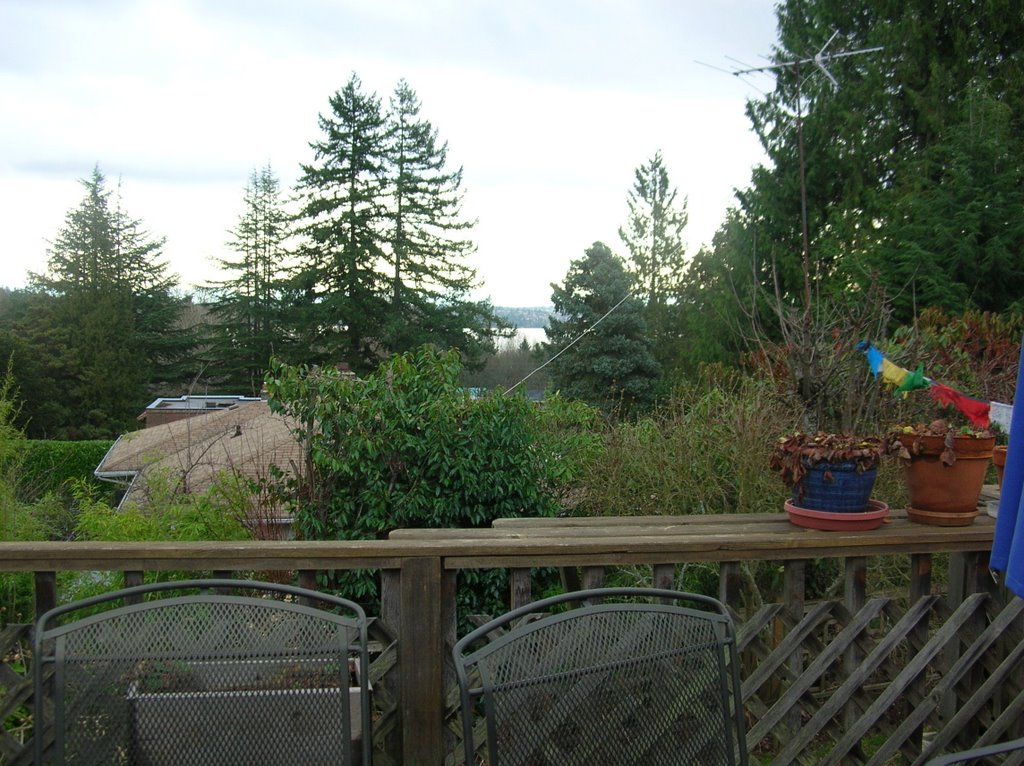
Looking into the Cascade mountain range from my backyard.


Well, that view is just a tiny bit telephotoed...

This is what I actually see from my backyard.


This is how the world usually looks around here these days -- including just a little while after the first photo.
(although earlier tonight it snowed, and it's still crystally and brilliant white)


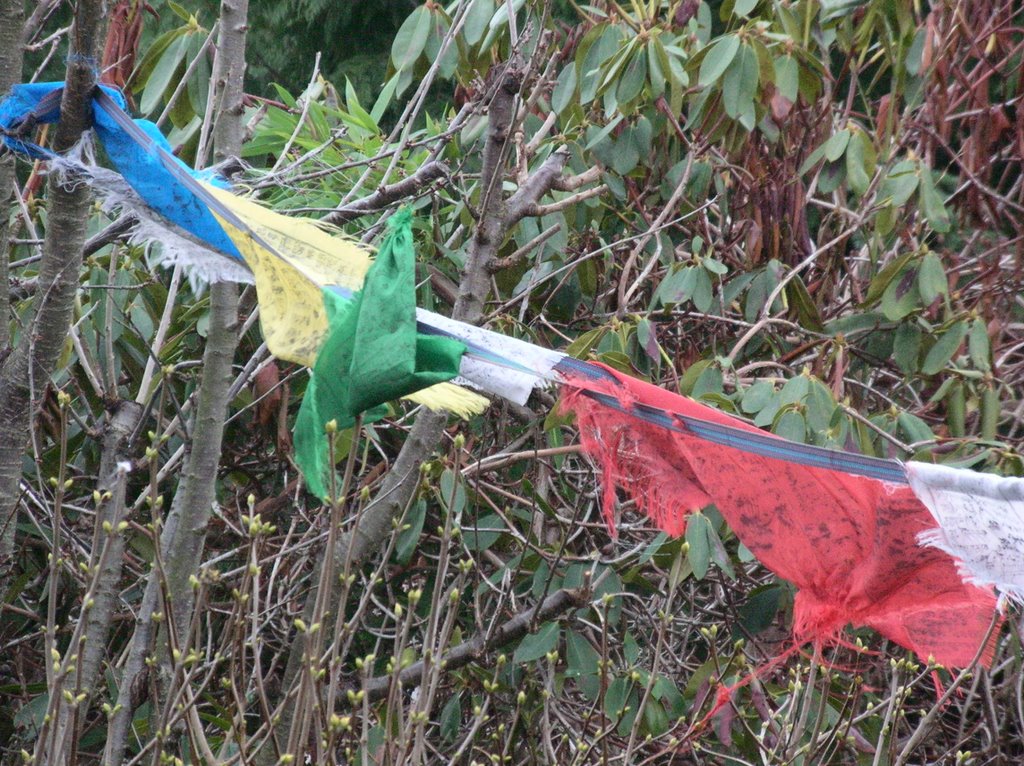
And this is how it feels sometimes: windblown, dampish, and getting frayed around the edges (but in the meantime, the prayers are dissolving into the air and are carried off by the wind)
I rediscovered some elemental fragments I contributed to Wings, the community playground that my friend Ashley used to host at Easily Amazed

Here is the part that tells about where we are now:
Winter and Water. Black and deep blue. Kidney, Bladder, bones, ears. Death and the "end" of the cycle. Reflection, stillness, depth, silence. Wisdom and the will to live. Water is the reservoir of our lineage (genetic and spiritual), our generative potency. It is the seeds in the dark, cold, silent ground full of intensely concentrated essence of future. The archetype of the Sage. Water is adaptable, enduring, patient, flows according to where the way is open, goes around obstacles, stores our power. The source of our capacity for awe.In his teachings on the elements, my friend Paul adds this: Water is community. Gathering. Things coming together. Sense of holding on, with feeling. Water practices: holding every moment as precious; deep listening.
Little update: still all water, all the time, mostly the frozen kind -- the prayer flags stiff and unmoving as the snow fell; just tonight starting to melt and drip and run down the hills or be drawn up into sky or stem or trunk. Just like the water in the world, the water moving in us can be frozen stiff, can rush and flood, can drip and penetrate, can soak and nourish...how does the water within you flow these days?

Friday, January 05, 2007

sacred conversation

Peggy Holman recently posted a beautiful article called "Evolution, Process and Conversation: A Foundation for Conscious Evolutionary Agency" to the Open Space listserv, originally written for the Evolutionary Life e-magazine.

In it, she wonders/suggests:
"Could it be that consciousness is the latest evolutionary innovation that, when applied to conversation, catalyzes a new form of social system, the conscious co-creative collective, the radiant network of deep community? I believe that conscious conversation is the path to what Thich Nhat Hanh imagined when he said: "It is possible that the next Buddha will not take the form of an individual. The next Buddha may take the form of a community, a community practicing understanding and lovingkindness, a community practicing mindful living. And the practice can be carried out as a group, as a city, as a nation." [Thich Nhat Hanh, "The Next Buddha May Be a Sangha" in Inquiring Mind, Vol 10, No.2, Spring 1994]

which reminds me of a teaching I read a couple of years ago -- a similar co-evolutionary idea in a different costume:
"'Messiah' in the original Hebrew is understood by the Kabbalists, quite astoundingly, to mean 'conversation'. Master Nachum of Chernobyl, mystic and philosopher, points out that the Hebrew word for messiah, Mashiach, can be understood as the Hebrew word Ma-siach -- Messiah, meaning 'from dialogue' or 'of conversation.' [Me'or Enayim, Parashat Pinchas] His assertion radically implies that the Messiah is potentially present in every human conversation -- every mutual act of voice-giving.

"All conversation is sacred. The ability to have an honest face-to-face talk in whihch both sides are true to themselves, vulnerable and powerful at the same time, is messianic. Simply put, sacred conversation is the vessel that receives the light of Messiah."

a radiant network

Monday, January 01, 2007

life awakens and is new

“Human breath is rooted in Divine breath, and Divine breath is inherent in human breath, reflecting the interdependent nature of the human and the Divine...

"Please ask yourself how long the breath of life that moves through you so freely at this very moment has been here. How long have these literal molecules circulated in one form or another in our world? …continue to breathe naturally and allow the question to touch your imagination lightly. There is no need to think of any particular answer...

"After you have considered how long your breath has been part of the world, extend your inquiry to include the molecules that make up your entire body. How long have these been around? How long has all of your body circulated around and around in our world, transforming from one form to another? Please engage this with your whole body and mind, allowing yourself to feel the question as it moves through every part of you...

"Remember, when the spirit or wind of creativity is brought to our tasks, and when we follow the example of the Creator and breathe life into what we undertake, life itself awakens and is new.”

Peter Levitt, Fingerpainting On the Moon: Writing and Creativity as a Path to Freedom

Thank you to Meredith, for showing the way to this book full of incandescent sparks.

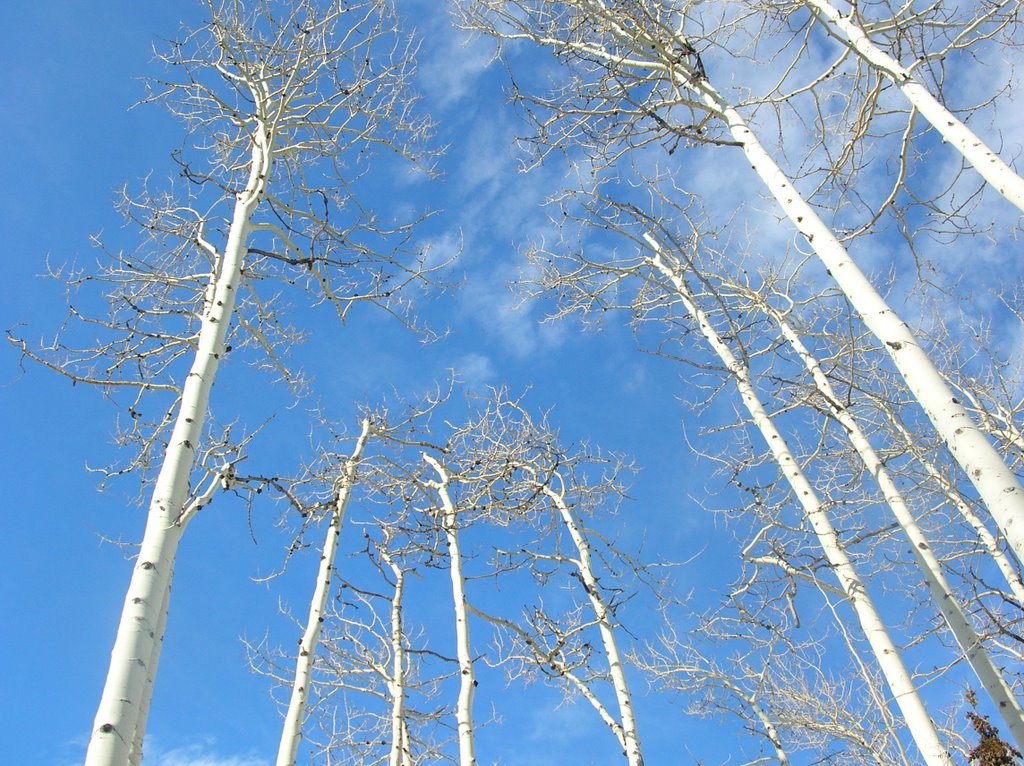
This photo is from a morning's showshoeing on Mt Werner in Steamboat Springs, Colorado, where we have been for the past week.
May this new year be as fresh, and enlivening, and may our interdependence with one another and the Divine become ever clearer.

Saturday, December 16, 2006

being a conduit

From Charity Focus' inspiration offering DailyGood quote of the day:

"Art condenses the experience we all have as human beings, and, by forming it, makes it significant. We all have an in-built need for harmony and the structures that create harmony. Basically, art is an affirmation of life."

From the artist's resume:

"I think about things that excite me: convoluted strata, the eroded and broken edges of cliffs, the constant interaction of the elements, the movement of boats on water…

I think about the object and its inner image; the activity of each and the play between the two and I try to be straightforward to remove unnecessary information.

For all the theorizing, formal and conceptual notions, the truth of the matter is that I see myself as a conduit. The titles come afterwards so that I don't impose myself on the work as it goes along. Then I leave it alone.

I have been saying the same thing all my working life. Just in different ways."

Tuesday, December 12, 2006

five micro stories

I was reading Chris' detailed, surprising and really interesting contribution to the "five things you might not know about me" story percolating around the blogworld. Then I got to the end and found that he'd handed me one of his five batons to carry on (though Chris, since you were tagged by Dan and two other friends, wouldn't you have 15 batons?) This is actually a combination of "you might not know" plus "I'm pretty sure you don't know" plus "maybe you do already know, I can't remember what I've said already":

1. My oldest boyfriend was (still is!) 30 years older than me. It was actually a pretty brief affair, and then we stayed friendly by letter. A few years later, after I was married, my husband and I got to visit with him and his lovely new wife when we were traveling through their part of the world. And then I got to reconnect with them again a couple of years ago after being out of touch for 15 years -- they are both still adorable.
One of the things I like best about being middle-aged is that there are friends you have loved for 20 or 30 or 40 years or more, and even if you have not seen them for many years there can still be such deep unchanged affection.

2. I have three sons, but usually I say that I have two, because our first little guy, Nadav, died at 12 weeks old of sudden infant death. While I am grateful to have had him for as long as we did, and am also grateful for my youngest who would not have been born without the loss of the first, and don't mind talking about him, I don't mention him much in public. My relationship with him continues in a very different form, a very interior form. His gradual appearance and swift disappearance from human form tenderized me forever and created the beginning of a gradual unfurling of the leaves of both my inner and outer life.

3. If it weren't poisonous, I would definitely be a smoker. I love the way smoke looks curling out of a cigarette, the drawing it in and blowing out. I don't actually even mind the smell so much, though my preferred cigarettes are filtered "kreteks" (Indonesian clove cigarettes) which have their own distinctive heavy-incense smell.

4. I have been to beautiful Indonesia, land of the kretek: after Robert and I got married we took almost all of our wedding gifts back to the stores, got money, and bought round-the-world tickets. We started in Los Angeles, spent a week in Hawaii, and then went to Asia for a year: Japan, China and Tibet, Hong Kong, Thailand, Malaysia, Indonesia, Burma, India and Nepal for from a few weeks to a few months in each country. Then about six more months spent partly on a kibbutz in the north of Israel, partly in Spain (my in-laws met us there for a whirlwind 4-star driving trip, so different from the way we'd been traveling! I hardly remember any of it, it was such a blur), then visiting friends in Paris and in London, and then back home.

5. The name I got from the Chinese side of my family (the other side being Japanese, by the way) is not our family's original name -- my grandfather bought the papers of someone named Lee to come to the US from China, but his family's name was really Kwan (or Quan depending on what system of transliteration you use). My husband's family changed their name, too, though only a generation before us -- his dad and uncles decided that "Eisikowitz" was too hard to spell (in fact I think I am spelling it wrong), and changed it to "Engel" (which hardly anyone spells correctly on the first try either!). If all that hadn't happened, instead of Lee-Engel, our last name would be Quan-Eisikowitz...has a different feel to it, doesn't it?

Here are some people I am very curious to know more about (curious, and not sure you will see this, so I am going to cheat and send you a note)(and please ignore this invitation if it doesn't sound fun to you):
Andy, Meredith, Thomas, Jon. And Doug, I am curious to see what aspects of you would come through your very poetic style. And I am definitely looking forward to reading what Ashley will write! (already tagged by Chris)

Friday, December 08, 2006

no less amazed

I so love it when I read my own vague thoughts and feelings expressed in someone else's simple, true, gently precise words:

Incomplete Knowledge
~Jeffrey Harrison

I am of those whose knowledge will always be
incomplete, who know something about the world
but not a whole lot, who will forever confuse
steeplebush and meadowsweet
but know at least by the shape of the flower
that it has to be one or the other.

Don't ask me the difference between
a pitch pine and a red, or even a Jeffrey,
though I know it's a pine, not a spruce or tamarack
(a.k.a. hackmatack, but what's a larch?).
The difference between a sycamore
and a plane tree? It's beyond me.

I've never had a real grip on
Japanese painting—the different periods and styles.
I don't even know that much about Dutch—
Vermeer of course, Rembrandt sure,
but could I distinguish a De Hooch from a Steen?
Do I even know how to pronounce their names?

I know next to nothing about what goes on
under the hood of a car, though I try to hide that fact
in the presence of mechanics. Herakleitus
(am I spelling that right?) said something
about how we hide our ignorance,
but I can't remember exactly what it was.

Birds, music, fishing, history, it's appalling
how limited my knowledge is.
I'm not even going to begin to list
all the books I haven't read.
I'm the antithesis of a Renaissance man,
spread so thin I hardly exist.

I have a friend who knows what seems like
close to everything. Certainly everything in the woods.
He was explaining to me the difference
between steeplebush and meadowsweet
(which I understood at the time but didn't retain,
as if it were the theory of relativity),

when I looked up and saw a jet whose trail
of fine white cloud kept disappearing, reappearing,
and disappearing again, and I asked why,
and, holding the meadowsweet in one hand
and the steeplebush in the other, he explained it.
And he wasn't bullshitting, either—he knew.

I'm not sure I even understand what it means
to know that much. Does all that knowledge
add up to some encompassing wisdom,
something beyond the sum of the names
and data, vast and unknowable? Unknowable
at least to me: I will never be like my friend.

I misplace facts as easily as my glasses,
so the world seems blurred for a while—
but then I find them, put them on, and go outside
to greet the ten thousand things (is that a Buddhist
or Taoist expression?), no less amazed
for my not being able to keep them straight.

(Today's selection at Poetry Daily)

Sunday, December 03, 2006

sleep and snow and melting into

I think that I got enough sleep last night for the first time in ages! I went to bed at 7:00 last night -- then around 7:30 the "Seattle Christmas Ship" docked at Matthews Beach (half a mile downhill from our house) and the Bellevue Chamber Chorus (through mighty loudspeakers) serenaded everyone for miles around with Christmas carols for 20 minutes before going on to their next stop along Lake Washington. So, I went to sleep at around 7:51, and didn't wake up till 8:30 this morning. Ahh! Satisfying my mammalian hibernation compulsion.

Plus, things have been very full lately. On Friday morning I went downtown to the "Building a WISER Sustainability Commons," which was inspiring and exciting & about which I will write later. Then went home for an hour, baked cookies for our office building's (the Seattle Healing Arts Center) holiday gala, and then with my 11-year old and his friend went to the fancy party which mixed tuxedos and string quartets and champagne with Cuban soul music and potluck desserts and little kids playing with surgical masks and an astrologer colleague dressed all in dazzing white including some kind of big ruff of snowy fur around his neck. Last year there were 400 guests, and I think this year there might have been more!

But I didn't stay too late because yesterday morning I had to get up early to catch the 9 am ferry to Whidbey Island, to join in a day-long workshop with poet David Whyte at the Whidbey Institute / Chinook Learning Center. Though last week's snow has pretty much disappeared from Seattle, there is still lots of snow and ice covering the fields and rooftops and driveways of South Whidbey, about a half an hour's drive and a 15 minute ferry ride away.

I am still mulling over the day's rich conversation, replete with stories and poetry and quiet time on that magnificent land, and will write more about that later, too.

In the meantime I'll just note that David Whyte has a beautiful new book of poetry out, called River Flow: New and Selected Poems 1984-2007. While I was paging through the book on the ferry ride home, I stopped at a favorite one, an unflinching and elemental poem called "Self-Portrait," from Fire in the Earth.

There is a very popular New Age-type poem that you can find quoted on coffee cups and greeting cards and such, called "The Invitation," that begins: "It doesn't interest me to know what you do for a living/ I want to know what you ache for/ and if you dare to dream of meeting your heart's longing..." I first saw it on a scrap of paper under the glass tabletop of the neighborhood teashop and liked it very much. A few years later I read David's poem and loved it very much, and was surprised to see the identical structure, so I looked for the website of the author of "The Invitation" and learned that she wrote it after a writing workshop with David where he gave them his poem as a writing exercise template. Here is the piercing original:

SELF-PORTRAIT
~David Whyte

It doesn't interest me if there is one God
or many gods.
I want to know if you belong or feel
abandoned,
if you can know despair or see it in others.
I want to know
if you are prepared to live in the world
with its harsh need
to change you. If you can look back
with firm eyes,
saying this is where I stand. I want to know
if you know
how to melt into that fierce heat of living,
falling toward
the center of your longing. I want to know
if you are willing
to live, day by day, with the consequence of love
and the bitter
unwanted passion of your sure defeat.

I have heard, in that fierce embrace, even
the gods speak of God.