Showing posts with label ashley. Show all posts

Friday, May 18, 2007

luminous edge, inside out, upside down, and backwards

Chris sat still for a while, as everyone moseyed out to chat in the lobby following Thomas' performance of Luminous Edge last night at Seattle Center. When he could speak again, he said with sparks of wonder lighting up each word, "Have you ever seen someone make art of what you do?" I thought (out loud), "it's like seeing yourself inside - out up there."

Chris writes more here about the intimate patterned dance of chaos and order, and the "process artist" practices of uncovering and understanding and supporting the natural patterns of human conversation and relationship and organization, and the way that Thomas (and Ashley, who was a matrix-deep collaborator in the creation of the show) illuminated it all in a deep and beautiful weave of sound and story and movement and image.

Two nights ago, I got to sit next to Ashley and her dad, Paul, and my friends Chris and Rick, for a talk by Paul Hawken who is on the lecture circuit with his latest book, Blessed Unrest: How the Largest Movement in the World Came into Being and Why No One Saw It Coming, which I wrote a little about last month. You can read the beginning of the book in issue 43 of Ode magazine.

Paul Hawken speaks with warmth and a sweet sense of humor, and deep appreciation for all of the many ordinary (and the few celebrated and extraordinary) people who have been growing the roots and branches of this movement.

Since first hearing him speak at the bioneers conference in October, I have been thinking a lot about his conviction that
The environmental movement seems to have the upper leg because the house is burning down. Literally. So it is very easy for the environmental movement to turn to the social justice movement and say, yes I know how important your issues are, but the house is burning down. You should come and join us on the environmental bus. I think that it is upside down and backwards. Global warming is injustice. It is a type of colonialism. If we are going to be effective over the short time we have, we have to slow down, stop, and change the bus. I think the environmental movement has to get on the social justice bus.
Whatever we call that bus, I think the process artists have an important and useful role to play, perceiving and nourishing and connecting and integrating the deep patterns that are most restorative and regenerative and healthy for the human and more-than-human lifeworld.
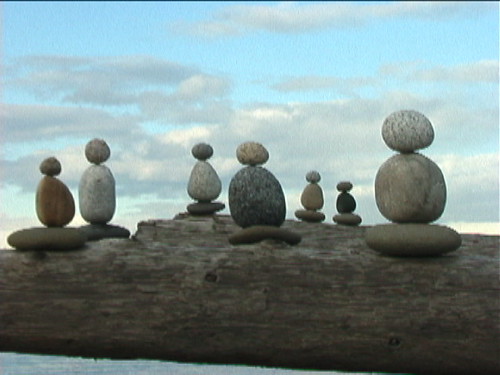

Photos by Ashley and Thomas

Sunday, January 28, 2007

one day it cracks them open

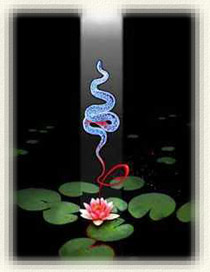
After talking today with a dear friend about his obviously powerful practice of kundalini yoga (a practice that awakens the energy lying like a serpent coiled at the base of spine, which then rises to enable the yogi's individual consciousness to merge with the Divine Consciousness), I remembered that my hero-friend Bill Mitchell practiced and taught a type of kundalini yoga for many years. I have had a sweet strong sense of Bill yesterday and today as a being who has suddenly shifted form, merged with the cosmos, gone super-nova, and become an intense radiance that has lit up the stars in our eyes... and now I recall a lovely comment that Chris wrote at Ashley's when a soul friend of theirs died a month ago at the solstice: "I have had this image with me all day of a star exploding, shedding layers and layers and seeding many new stars all around."

So many new stars.

I think that this star-burst/snake-uncoiling energy is an ecstatic one. An energy that takes us far beyond our ordinary sense of who we are, beyond where we think we end and the rest of the universe begins. A power that we experience at numinous times like these, when the veil floats aside for a moment and we are tossed high and low by the great winds of life and death. When we feel pinned through the heart to this present time; and when there's nothing left of us to be pinned, because we've already been dissolved into the fertile emptiness.

An energy to appreciate, and maybe, like my friends, to cultivate.

"Many myths...speak of a snake that glides, sinuous and silent, through the shimmering branches of the body-tree. Universally, the snake symbolizes the primordial creative energy of the cosmos in general and the life force within the body in particular. What we call ecstasy is the dance of the serpent through the tree of our consciousness.
--
"If you think of your body as a house, the serpentine force is the electricity that flows through all the rooms and lights them up. Seen with the inner eye, every living body appears luminous -- it shines, shimmers and scintillates, each cell a little star.
--
"Ecstasy is always a gift of grace. Its comings and goings cannot be controlled...Or, as Rumi puts it, "God's joy moves from unmarked box to unmarked box."
~Jalaja Bonheim, PhD

Unmarked Boxes
Jalal al-din Rumi
translated by Coleman Barks


Don't grieve. Anything you lose comes round
in another form. The child weaned from mother's milk
now drinks wine and honey mixed.

God's joy moves from unmarked box to unmarked box,
from cell to cell. As rainwater, down into flower bed.
As roses, up from ground.
Now it looks like a plate of rice and fish,
now a cliff covered with vines,
now a horse being saddled.
It hides within these,
till one day it cracks them open.

Part of the self leaves the body when we sleep
and changes shape. You might say, "Last night
I was a cypress tree, a small bed of tulips,
a field of grapevines." Then the phantasm goes away.
You're back in the room.
I don't want to make any one fearful.
Hear what's behind what I say.

Tatatumtum tatum tatadum.
There's the light gold of wheat in the sun
and the gold of bread made from that wheat.
I have neither. I'm only talking about them,

as a town in the desert looks up
at stars on a clear night.

Sunday, November 26, 2006

the full of life is infinite

(For Thomas, whose seat I sat in when his travel plans conflicted with his tickets to see the Butoh troupe Sankai Juku on Tuesday, and thank you dear Ashley for the invitation to sit there!)

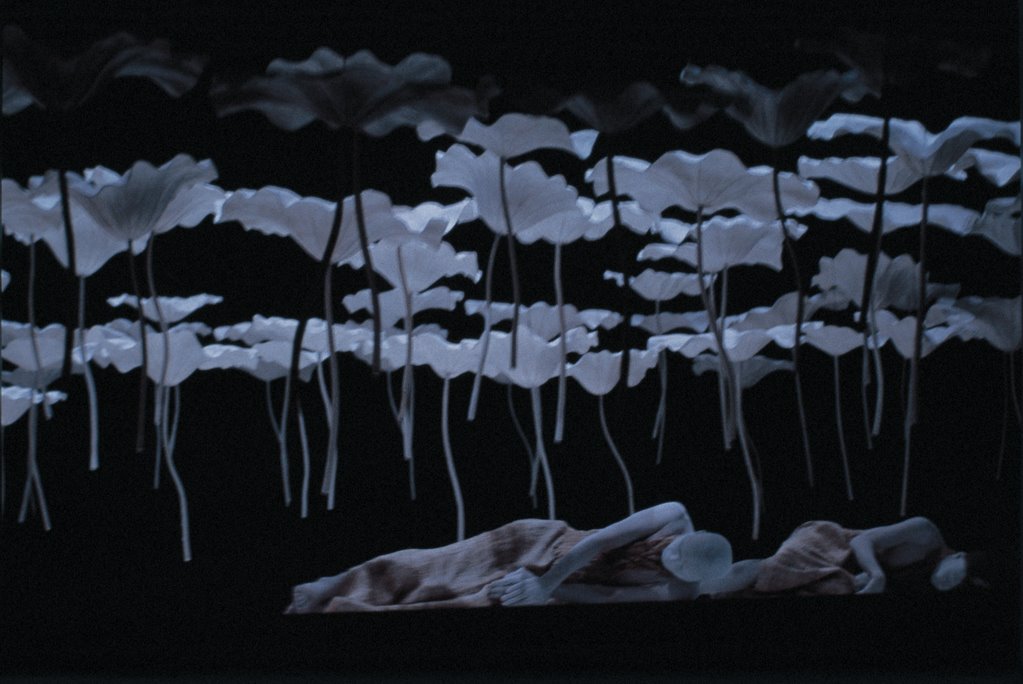
Lotus Leaves
"Inspired by the meeting with Mr. Riho Senba, the headmaster of the "koryushooukai" school of Ikebana (the art of Japanese flower arrangement)"

~from the program notes of Kagemi: Beyond the Metaphors of Mirrors

The Kage of Kagemi is shadow
The light of contrast, the image in the mirror of water's surface
The
mi is seeing and being seen

Some say
Kagemi is the ancient origin of "mirror" (kagemi)

In light, the surface that reflects and is reflected, looked into and looking back

Surface beginning in the horizontal water plane and transforming to the perpendicular face

From an ambiguous and transient state to one clearly outlined

The right hand asks, the left hand answers

Once an imaginary sur-face is defined

~Amagatsu Ushio, Sankai Juku founder, Director, Choreographer and Designer.


The day after the performance, a friend who had also been there said that a difference between modern dance and butoh is that in modern dance the choreographer and dancer will observe a tree or water, and create movement that evokes tree or water; in butoh the dancer becomes tree, or water.

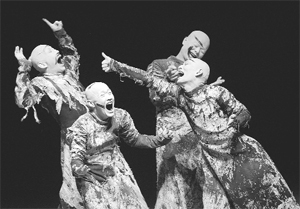
The act of watching becomes a visceral act. Being lulled by the endlessly slow drift of an arm or a leg. In trance and then restless as bodies shift in complex patterns, none of it comprehensible to the mind. So much happens in the lift of the eyelids, in the shapes of the fingers carried like upturned claws or tipped in blood-red paint, in the expressionless mask broken suddenly open in hilarity or howl (which? or both?). Even the faint white clouds arising as the powdered bodies of the dancers quickly cross the stage contribute to the stunning scene. The final image felt too like waves falling, rising: the luminous leaves lowered down to the stage again (where they were at the beginning hovering just above the floor), the dancers reclining on the floor between the descended stems, then lying down as the lights dim. The tiny spotlights on hands rising above the surface of the leaves, fingers alive like birds or blossoms breaking bud.

I Wind in the Water Depths
II MANEBI -- two mirrors
III Echoing of gaze and return gaze
IV In the light by the waterside
V Infinite dialogue
VI Empty / Full
VII CHIRAL / ACHIRAL, Agitation and Sedimentation


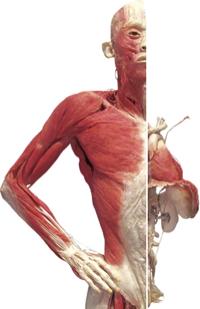
Then, on Sunday my 16 year old son and I went to see BODIES: The Exhibition (choosing to go at probably the most crowded time possible), which he has wanted to see since it opened.

Like the intensely expressive. perfectly formed, dancers' bodies, these bodies were amazing, too -- impeccably, exquisitely dissected human cadavers (not without controversy, see here), preserved with a kind of silicone polymer that arrests decay and hardens the tissues. A number of the bodies are posed in athletic gestures, diving to dig a volleyball or poised to shoot a basketball or arm stretched overhead to serve a tennis ball. Others are simply seated or standing to display something particular such as the layers of the spinal cord, or muscle and joint layers. The most mind-boggling to me (having spent many hours during the first year of medical school in dissection lab and knowing how easy it is to do an awful job of it) were the entirely dissected-out, lifted from the rest of the body, nervous system and circulatory systems (arteries and veins). There are also displays of organs both healthy and diseased (no matter how many times I see it, it is always shocking to see lungs that are black from years of smoking, compared with normal lungs that are greyish pink with spots of black from pollution -- spots we've all got, so that "normal" and "healthy" might not be exactly the same thing...)

The choices of what to remove and what to leave were a little curious, I thought -- faces were dissected to remove most of the skin and connective tissue, but eyelids and lips and ears were left, and sometimes fingertips and genitalia, so that you did have a sense of the someone who wore this body at one time. By leaving those features, the bodies definitely looked like people, not just like generalized human specimens.

It is interesting to me that these actual viscera didn't have a visceral effect on me, fathoms away from the internal movement stirred by the living, moving butoh dancers' bodies.

Also interesting to me is that all of these bodies are Asian bodies like mine (except that all of the dancers and most of the cadaver specimens are male), so that the surface of what I was seeing was maybe a little bit more mirror-like for me than it might have been. At one point I heard a woman in the Bodies exhibition say something like, "well, he still looks like the chinaman that he was" and I turned around to stare, surprised to hear a term I haven't heard for decades, but I couldn't tell who had said it (it really was crowded there!). The warmth of the crowd and the buzz of conversation and exclamations, as we milled around the exhibits in our own self-organized choreography, generated a current of liveliness that both encompassed and contrasted with the formerly-alive. My son and I noticed and sometimes shared people's reactions of fascination, wonder, revulsion, wistfulness, reverence, and even a resistance to being amazed ("they're just dead bodies, what's the big deal?" ~overheard while standing in the line to get in)

Sankai Juku's Amagatsu-san points to: the surface that reflects and is reflected, looked into and looking back
"Kagemi" explores what happens behind mirrors, said founder and artistic director Ushio Amagatsu, speaking in Japanese through an interpreter by phone from Tokyo. The performance begins by using the surface of water as a mirror, he said. "It's real, but not real."

Seven scenes contrast life and death, ash and blood, sand and water. Knowing about death allows you to realize what kind of life you can live, Amagatsu said. "If you think about yourself, there's a beginning and an end, but the full of life is infinite." In other words, individual lives emerge and disappear, but human life is continuous.
~The Seattle Times
Not only human life, but just life, the one life, pouring through the exquisiteness of all of these individual forms; the more forms we see, the more we may see our self, looking back at us.

Tuesday, January 11, 2005

twinkles & sparkles

"Twinkles" is what our Japanese friend Kaori-chan* said for "twins" (her charming English also included "Mekeesko" for "Mexico," and that has become my preferred pronunciation too ;-))

In the past week I've gotten to have time with two good friends who seem quite different on superficial first glance but whom I now realize are "soul twinkles," including the way that both of them sparkle and fizz up a room. Last week deep and buoyant, easily-amazed Ashley was in town to visit, and today I got to have lunch with elf-friend Anne Stadler, as curious and playful and exuberant in her 70's as any 6-year old. It turns out that Ashley and I had tea, and then Anne and I had BBQ chicken and coleslaw, on different days in the same place: the great community living room (that is, a living room with a bookstore, restaurants, a farmers' market and a bakery), Third Place Commons which Anne and her husband Dave helped to found.

I met both Ashley and Anne at the Practice of Peace last November, an extraordinary Open Space gathering (most all Open Space gatherings are extraordinary, according to those who have had lots of experience, but this one was especially special) that continues to ripple out into the world in good works and heartful connections. With both Ashley and Anne, I have the sensation of being held in very spacious embraces, able to bask in their radiant and warm wonder and joy, which relaxes and nourishes many of my little crimped corners and dried rootlets, and gives me modeling and support for the ongoing practice of remembering to pay deep attention to what Swami Omkar calls Adorable Presence, as well as to what Anne calls "the new We" (-- sounds like the same thing, to me).

When Ashley comes back through Seattle next month, I'll get to reconnect the two of them with one another and bask some more -- just as good as a vacation in the sun.
(*in Japanese, adding -san onto the end of someone's name is an honorific and indicates respect; adding -chan is like a "cute-erific" and indicates affection and mostly you would use it with girls and women younger than yourself)