Showing posts with label beautydialogues. Show all posts

Tuesday, January 08, 2008

beannacht, embraced by beauty

I learned from the Panhala poetry listserv of the recent and sudden passing of Irish theologian - poet - philosopher John O'Donohue, the author of many books including Anam Cara: A Book of Celtic Wisdom, and Beauty: The Invisible Embrace -- Rediscovering the True Sources of Compassion, Serenity, and Hope. And of the following favorite blessing, sent out by Joe of Panhala yesterday:


[Last Friday, Barbara Knight Katz, a member of Panhala, wrote to inform me that John O'Donohue had died unexpectedly. In Barbara's words, "John's life was a blessing to all of us who knew and loved him, and to all who love his poetry and wisdom." His life was a blessing; the world needs all the divinely mad Irishmen it can get....]


"I would love to live like a river flows, carried by the surprise of its own unfolding."
-- John O'Donohue
Beannacht
("Blessing")
On the day when
the weight deadens
on your shoulders
and you stumble,
may the clay dance
to balance you.
And when your eyes
freeze behind
the grey window
and the ghost of loss
gets in to you,
may a flock of colours,
indigo, red, green,
and azure blue
come to awaken in you
a meadow of delight.
When the canvas frays
in the currach of thought
and a stain of ocean
blackens beneath you,
may there come across the waters
a path of yellow moonlight
to bring you safely home.
May the nourishment of the earth be yours,
may the clarity of light be yours,
may the fluency of the ocean be yours,
may the protection of the ancestors be yours.
And so may a slow
wind work these words
of love around you,
an invisible cloak
to mind your life.

~ John O'Donohue ~
(Echoes of Memory)


John O'Donohue's dear friend, fellow poet and lover of Ireland David Whyte, wrote a warm and sad and loving tribute to his friend, which finishes as, it should, with a poem:
...John was a love-letter to humanity from some address in the firmament we have yet to find and locate, though we may wander many a year looking or listening for it. He has gone home to that original address and cannot be spoken with except in the quiet cradle of the imagination that he dared to visit so often himself. As a way of sending a love letter in return, I wrote this poem for him a good few years ago. I hope it can still reach him now, wherever he is to be found and that he finds it as good a representation as he did when he lived and breathed. I remember the bright, surprised and amused intelligence in his eyes when I first read it to him, sitting by his fire in Connemara. It brings him back to me even as I read it now, as I hope it does for you.

Looking Out From Clare
For John O'Donohue

There’s a great spring in you
all bud and blossom
and March laughter
I’ve always loved.

Your face framed
against the bay
and the whisper
of some arriving joke
playing at the mouth,
your lightning raid
on the eternal
melting the serious line
to absurdity.

I look around and see
the last days of winter
broken away
for all those
listening or watching,
all come to life now
with the first pale sun on their face
for many a month,
remembering how to laugh.

But most of all I love
the heft and weight
and swing of that sea
behind it all, some other tide
racing toward the shore,
or receding to the calmness
where no light or laughter
lives for long.

The way you surface
from those atmospheres
again and again,
your emergence seems to make
you a lover of horizons
but your visitation
of darkness shows.

Then away from you
I can see you only alone
on the strand
walking to the sea
on the north coast of Clare
toward the end
of an unendurable winter
taking your first swim
of the year.

The March scald
of cold ocean
even in May about to tighten
and bud you into spring.

You look across
to the mountains in Connemara
framing, only for now,
your horizon.

You look and look, and look,
beyond all looking.

David Whyte

Friday, April 27, 2007

i've been waiting for this moment for all my life

Like "Pearls Before Breakfast", the Washington Post's article about an experiment to see what would happen when acclaimed violinist Joshua Bell performed anonymously as a busker in the Washington, DC Metro station during commute time (tiny video clip accompanies that article, and audio of the full performance is here), this video of art unfurling as a gift in a public space has been going around:


In an email conversation with some of the Beauty Dialoguers about the Washington Post article, Thomas wrote:
The curious relationship between time and beauty. . . How much nourishment of soul we lose when space and time are so deeply contracted around us.

The article brought up a memory of my own glorious street performing career. Mid-eighties in Seattle; I was without any money for a few weeks. Every day at lunch hour I'd go to an outdoor plaza at a downtown skyscraper. It was in front of a sweet little restaurant that had windows lining the courtyard where I would juggle for an hour. I remember it being really cold. I would wear fingerless gloves and just practice the hour away. I would make five or six bucks which I'd use for breakfast the next morning. After my fingers were frozen and my hour was up (and the lunchrush was over) someone from the restaurant would come out and invite me in where I would feast of the special of the day. The staff loved me. The folks on lunchbreak barely seemed to notice.
and Kara added:
As an artist, I am so grateful that our perception of when we allot time for beauty made its way into a mainstream newspaper.
There are people who seem to set a specific time for beauty, and assume that much money has to be spent for this appreciation to be valuable. I have had much luck selling humble prints in leisurely places where people are open to absorb as much beauty as they can, like on Hawaiian beaches (selling one print in the morning ensured my food for the day, so I could surf for the rest of it!;) or festivals.
I first saw this video of singing group Naturally7 (as well as the Joshua Bell article) at Patti Digh's 37Days, as part of her National Poetry Month Poemapalooza, and she got it from Sue Pelletier, (whose post includes another interesting video) and then a few days later I saw it again as the Video of the Week from KarmaTube. They accompanied it with these recommendations: "1) Experience your daily routine as if encountering it for the first time. What's new and different about today? 2) Send a note of gratitude to Naturally7, through the group's manager Birgit Kurth 3) Give way to joy."

I am grateful that I can benefit from other people's sensitive antennae, and being alerted to what they've noticed reminds me to practice stopping, and sinking in, and sensing this and every moment full of the exuberance of the world -- which we, as part of that outpouring of creation, are so perfectly attuned to recognize, our senses matching exquisitely what there is for us to sense.
"If you really want to hear with penetration and find its associated pleasures, you must imagine you are waking up over and over again -- waking on your feet, becoming aware 'in media res.' "(in the midst of things)
~ Stephen Kuusisto, Eavesdropping: A Memoir of Blindness and Listening
Thomas, by the way, is performing someplace warmer now -- in a few weeks he is presenting the world premiere of Luminous Edge, a show commissioned by the Seattle International Childrens Festival, tickets here.

Sunday, November 26, 2006

the full of life is infinite

(For Thomas, whose seat I sat in when his travel plans conflicted with his tickets to see the Butoh troupe Sankai Juku on Tuesday, and thank you dear Ashley for the invitation to sit there!)

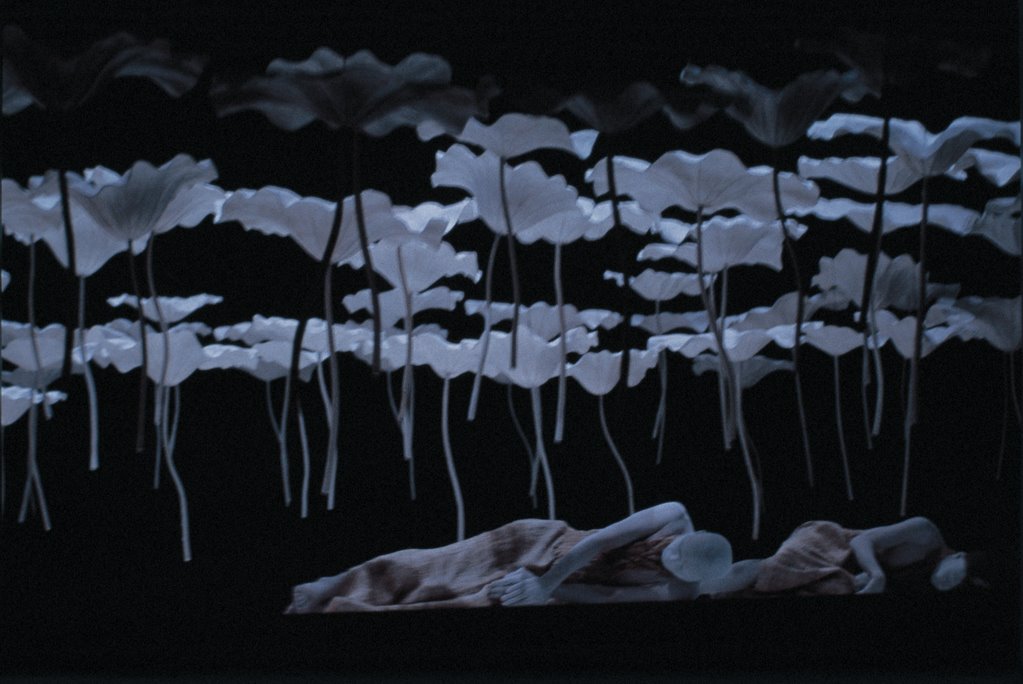
Lotus Leaves
"Inspired by the meeting with Mr. Riho Senba, the headmaster of the "koryushooukai" school of Ikebana (the art of Japanese flower arrangement)"

~from the program notes of Kagemi: Beyond the Metaphors of Mirrors

The Kage of Kagemi is shadow
The light of contrast, the image in the mirror of water's surface
The
mi is seeing and being seen

Some say
Kagemi is the ancient origin of "mirror" (kagemi)

In light, the surface that reflects and is reflected, looked into and looking back

Surface beginning in the horizontal water plane and transforming to the perpendicular face

From an ambiguous and transient state to one clearly outlined

The right hand asks, the left hand answers

Once an imaginary sur-face is defined

~Amagatsu Ushio, Sankai Juku founder, Director, Choreographer and Designer.


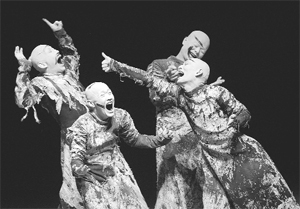
The day after the performance, a friend who had also been there said that a difference between modern dance and butoh is that in modern dance the choreographer and dancer will observe a tree or water, and create movement that evokes tree or water; in butoh the dancer becomes tree, or water.

The act of watching becomes a visceral act. Being lulled by the endlessly slow drift of an arm or a leg. In trance and then restless as bodies shift in complex patterns, none of it comprehensible to the mind. So much happens in the lift of the eyelids, in the shapes of the fingers carried like upturned claws or tipped in blood-red paint, in the expressionless mask broken suddenly open in hilarity or howl (which? or both?). Even the faint white clouds arising as the powdered bodies of the dancers quickly cross the stage contribute to the stunning scene. The final image felt too like waves falling, rising: the luminous leaves lowered down to the stage again (where they were at the beginning hovering just above the floor), the dancers reclining on the floor between the descended stems, then lying down as the lights dim. The tiny spotlights on hands rising above the surface of the leaves, fingers alive like birds or blossoms breaking bud.

I Wind in the Water Depths
II MANEBI -- two mirrors
III Echoing of gaze and return gaze
IV In the light by the waterside
V Infinite dialogue
VI Empty / Full
VII CHIRAL / ACHIRAL, Agitation and Sedimentation


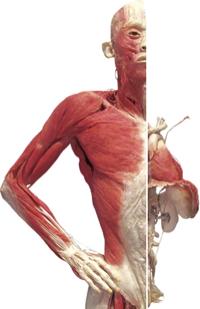
Then, on Sunday my 16 year old son and I went to see BODIES: The Exhibition (choosing to go at probably the most crowded time possible), which he has wanted to see since it opened.

Like the intensely expressive. perfectly formed, dancers' bodies, these bodies were amazing, too -- impeccably, exquisitely dissected human cadavers (not without controversy, see here), preserved with a kind of silicone polymer that arrests decay and hardens the tissues. A number of the bodies are posed in athletic gestures, diving to dig a volleyball or poised to shoot a basketball or arm stretched overhead to serve a tennis ball. Others are simply seated or standing to display something particular such as the layers of the spinal cord, or muscle and joint layers. The most mind-boggling to me (having spent many hours during the first year of medical school in dissection lab and knowing how easy it is to do an awful job of it) were the entirely dissected-out, lifted from the rest of the body, nervous system and circulatory systems (arteries and veins). There are also displays of organs both healthy and diseased (no matter how many times I see it, it is always shocking to see lungs that are black from years of smoking, compared with normal lungs that are greyish pink with spots of black from pollution -- spots we've all got, so that "normal" and "healthy" might not be exactly the same thing...)

The choices of what to remove and what to leave were a little curious, I thought -- faces were dissected to remove most of the skin and connective tissue, but eyelids and lips and ears were left, and sometimes fingertips and genitalia, so that you did have a sense of the someone who wore this body at one time. By leaving those features, the bodies definitely looked like people, not just like generalized human specimens.

It is interesting to me that these actual viscera didn't have a visceral effect on me, fathoms away from the internal movement stirred by the living, moving butoh dancers' bodies.

Also interesting to me is that all of these bodies are Asian bodies like mine (except that all of the dancers and most of the cadaver specimens are male), so that the surface of what I was seeing was maybe a little bit more mirror-like for me than it might have been. At one point I heard a woman in the Bodies exhibition say something like, "well, he still looks like the chinaman that he was" and I turned around to stare, surprised to hear a term I haven't heard for decades, but I couldn't tell who had said it (it really was crowded there!). The warmth of the crowd and the buzz of conversation and exclamations, as we milled around the exhibits in our own self-organized choreography, generated a current of liveliness that both encompassed and contrasted with the formerly-alive. My son and I noticed and sometimes shared people's reactions of fascination, wonder, revulsion, wistfulness, reverence, and even a resistance to being amazed ("they're just dead bodies, what's the big deal?" ~overheard while standing in the line to get in)

Sankai Juku's Amagatsu-san points to: the surface that reflects and is reflected, looked into and looking back
"Kagemi" explores what happens behind mirrors, said founder and artistic director Ushio Amagatsu, speaking in Japanese through an interpreter by phone from Tokyo. The performance begins by using the surface of water as a mirror, he said. "It's real, but not real."

Seven scenes contrast life and death, ash and blood, sand and water. Knowing about death allows you to realize what kind of life you can live, Amagatsu said. "If you think about yourself, there's a beginning and an end, but the full of life is infinite." In other words, individual lives emerge and disappear, but human life is continuous.
~The Seattle Times
Not only human life, but just life, the one life, pouring through the exquisiteness of all of these individual forms; the more forms we see, the more we may see our self, looking back at us.