From StoryPeople's Brian Andreas:
...If there is any secret to this life I live, this is it: the sound of what cannot be seen sings within everything that can. & there is nothing more to it than that.
...If there is any secret to this life I live, this is it: the sound of what cannot be seen sings within everything that can. & there is nothing more to it than that.
...The hardest struggle of all is to reconcile life's polar realities. I love books, Beethoven, and chocolate brownies. Yet how do I justify my pleasure in these in a world where millions are illiterate, the music never plays, and children go hungry through the night? How do I live sanely in a world so unsafe for so many?
I don't know what they taught you here at Hamilton about all this, but I trust you are not leaving here without thinking about how you will respond to the dissonance in our culture, the rivalry between beauty and bestiality in the world, and the conflicts in your own soul. All of us have to choose sides on this journey. But the question is not so much who we are going to fight against as it is which side of our own nature will we nurture: The side that can grow weary and even cynical and believe that everything is futile, or the side that for all the vulgarity, brutality, and cruelty, yearns to affirm, connect and signify. Albert Camus got it right: There is beauty in the world as well as humiliation, "And we have to strive, hard as it is, not to be unfaithful...in the presence of one or the other".
That's really what brings me here this afternoon. I did put myself in your place, and asked what I'd want a stranger from another generation to tell me if I had to sit through his speech. Well, I'd want to hear the truth: The truth is, life's a tough act, the world's a hard place, and along the way you will meet a fair share of fools, knaves and clowns--even act the fool yourself from time to time when your guard is down or you've had too much wine. I'd like to be told that I will experience separation, loss and betrayal, that I'll wonder at times where have all the flowers gone.
I would want to be told that while life includes a lot of luck, life is more than luck. It is sacrifice, study, and work; appointments kept, deadlines met, promises honored. I'd like to be told that it's okay to love your country right or wrong, but it's not right to be silent when your country is wrong. And I would like to be encouraged not to give up on the American experience. To remember that the same culture which produced the Ku Klux Klan, Tom DeLay and Abu Ghraib, also brought forth the Peace Corps, Martin Luther King and Hamilton College.
And I would like to be told that there is more to this life than I can see, earn, or learn in my time. That beyond the day-to-day spectacle are cosmic mysteries we don't understand. That in the meantime--and the meantime is where we live--we infinitesimal particles of creation carry on the miracle of loving, laughing and being here now, by giving, sharing and growing now.

"We will climb together not as individuals who belong only to this or that nation or faith, but as a team who all share a common home: the earth. By bringing people together from different cultures we will be setting an inspirational example of courage, friendship and teamwork - and through our Peace Climbs show the world that people from various faiths can live together, work together, and depend on each other while doing something extraordinary..."They are also raising funds for Room to Read, an organization which has partnered with rural communities all across Asia by providing challenge grants and donating expertise to build schools, establish libraries and fill them with donated books, establish computer and language labs, and provide scholarships to underprivileged girls.
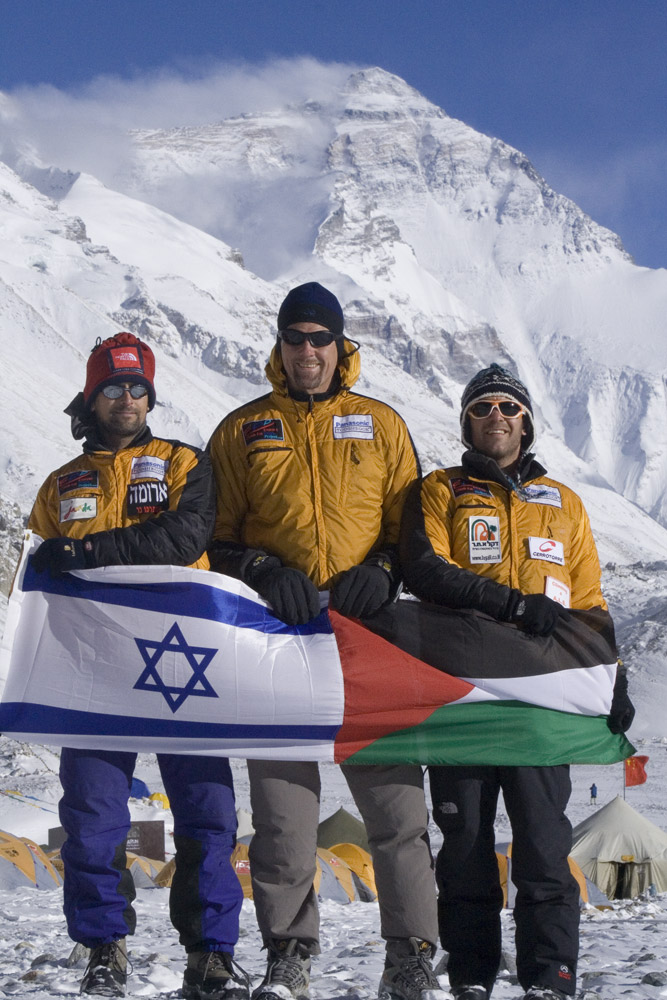 David (Dudu) Yifrach, Ali Bushnaq, and Micha Yaniv holding the Israeli and Palestinian flags joined together
 The real does not die, the unreal never lived. --Nisargadatta Maharaj
 Our practice for the week of Tzav is to journey to the fire on the altar of your heart and listen to its voice.This week, Parashat Shimini:
Tzav asks us to enter within and inspect the condition of the innermost fire upon the altar of the heart. We are challenged to look at our lives and ask the serious and probing questions about what supports that fire as well as what puts it out.
--Nadav and Avihu, the sons of Aaron, took each of them his censer, and put fire in it, and put incense on it, and offered strange fire before G-d, which He commanded them not. And a fire went out from G-d, and consumed them, and they died before G-d. (Leviticus 10:1-2)
They approached the Supernal Light out of their great love of the Holy, and thereby died. Thus they died by "divine kiss" such as experienced by the perfectly righteous; it is only that the righteous die when the divine kiss approaches them, while they died by their approaching it... Although they sensed their own demise, this did not prevent them from drawing near to G-d in attachment, delight, delectability, fellowship, love, kiss and sweetness, to the point that their souls ceased from them. (Ohr HaChaim)(via Chabad.org)
If someone could see into your heart, the deepest part of you, and really see what it is that you've been trying to do all this time, what is it that they would thank you for?I am thanked for for that, I think. For being willing to look in the heart-part of people, and to appreciate and bless their particularness (which is their own genius) and for being a warm and kind and not-sticky place where people can glide and blow through and sidle up as themselves without any guilt or shame. I don't manage to do it all the time, but I am practicing.
"The Council of All Beings is the ceremonies and rituals that bring our deep ecology to life. Here we have a practice where we approach a leaf as though approaching our revered zen master. We breathe to this leaf the oxidized carbon of our body. We do so with the gratitude and the generosity that is the signature, the clue to the Nature of which we are a fragment.
As we add consciousness to the ancient processes of sharing respiration, we savor the leaf in our imagination. Now we must notice and then lay aside our prejudice that humans are the only ones capable of consciousness in this transaction, this holy communion that accompanies our every breath. We consciously nourish a leaf and invite the leaf to nourish us, not just with the oxygen it creates, but with futher communications.
(...)
Plants! Herbs!
Of course they feed us! Of course they heal us! Of course they get us high! We've been co-operating together for eons before arrogance and amnesia set in, they are the manner in which we are rooted in biology, they mediate between us and the sun.
...Ahhh, photosynthesis! Back to the ultimate miracle of sunlight itself, energy with the propensity, the delight, to weave itself into all this."
 baby fronds of Japanese Painted Fern Athyrium niponicum "Pictum"
 alignments of the planets, and human cultural, political, historical events.
 The "Events" page of Mosaic: Voices of Youth, Voice of Community. Mesmerizing, street-wise, funny storyteller and mythologist Michael Meade will be doing a presentation in his series "Peace and Poetics", called "Faith and Destiny: The Two Agreements in Life" on Friday 4/14 at the Langston Hughes Performing Arts Center.
"During this part of the depth diagnosis process it is no longer necessary to actually be in the presence of the phenomenon being studied. It is carried daily within you in the imagination. This is also why the first moment of contact is so important. That initial perceiving and the moods that it generated remain with a sparkling clarity within the participatory heart. The emergence of the demanded mode of representation takes time. Depth diagnosis, for me, can take from fifteen minutes to a month or more, depending on the person and the problem. (The average is about two weeks.)"The next tab is the BerkanaExchange, on the first of three pages containing A Smorgasbord of Art of Hosting Resources, inspired by a rich few hours the Imagine Cascadia host team got to spend with the Art of Hosting's Toke Moller, last week. From Toke's paper "What Gifts Could Learning and Courage Bring Our Societies?":
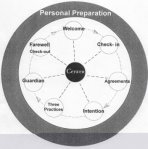
"Here are some of my assumptions about creating learning space and starting conversations that matter…Next tab: the commencement address from last June's Harvard Divinity School graduation, by Dr. Kimberly Potter (that one's been open for a few days now!):
- In this time, the ways in which we are together have become very speedy, uninspired and often unconscious of what is really meaningful to us - this gives us little space to be present in the Now – to be present to ourselves and each other.
- When we open space and time to each other around our own meaning, inspiration and consciousness is already there to greet us.
- We need to be fully present, connected to ourselves and each other, to have the inspiration and courage to know and decide what to create and do at this time, that will benefit all and not just me…..
- I cannot give if I do not have the surplus of love, challenge and freedom in human community with others.
- Life wants to give its best to what is alive and let die what is no more needed.
- When I let myself become the dialogue, the process and the learning I am in, that experience gives birth to conscious action ……..that will make a difference."
"The study of religion has never been a "field" for me as much as it has been a labyrinth. Having entered this maze, like many other scholars, I have never truly emerged, lost in a world well beyond my comprehension or "control," but whose twists and turns I continue to follow because I must, sensing that there is somewhere, hidden deep down, a chamber I probably should avoid but cannot. To study religion is to encounter a fire—a funeral pyre at times, the burning nest of a phoenix at others; a river of ashes into which I wade at dawn straining to hear the Gayatri mantra; an alchemical crucible; a Pentecostal shout; a frog's splash, awakening Basho. It is the majesty of the Kol Nidre or the Ethiopian Orthodox liturgy; the first steps of the hajj; a Maori war outrigger flying across the surf, the realm of the sea god Tangaroa..."Then, the website of Dottore Massimo Mangialavore, brilliant Italian surgeon and homeopath. You will have to go over there to read his articles and interviews, since all his material is copyrighted.
"We envision a healthcare system that is multidisciplinary and enhances competence, mutual respect and collaboration across all healthcare disciplines. This system will deliver effective care that is patient-centered, focused on health creation and healing and readily accessible to all populations."He's only been blogging for a few weeks and there is already a ton of information there. Important reading for anyone interested in the history, business and public policy aspects of integrative and collaborative medicine and the creation of a healthy health-care system.
...So, as long as I thought I could impart to you something oracular about the future—your future—something splendid or clever or wise, I never had this opportunity. That day did not come until all I could tell you about was the one thing that I truly can say I know, and that is the broken heart. Even if a broken heart does not lie in your past or present, it awaits you in your future, at some place, at some time when you will almost certainly be unprepared. But in myth, in ritual, and in theology, the broken heart is not a regrettable symptom of derailment, but is rather the starting point of anything that matters. As Laurette Séjourné describes the heart in ancient Mesoamerica: "The heart is the place of union where the luminous consciousness is made. . . . Human existence must reach out to transcend the world of forms that conceal the ultimate reality. This reality lives in the heart and must be set free at whatever cost. . . . Thus to reach one's heart, to possess oneself of it, means to penetrate into spiritual life. The operation is extremely painful, and that is why the heart is always represented as wounded, and why the drops of blood issuing from it are so significant that they alone are a sufficient symbol for it."The Torah portion that I'll be chanting from and giving a little talk on in June includes Moses telling the people "cut away the thickening around your heart" (literally: "circumsize the foreskin of your heart" "umal'tem et orlat l'vavechem") so I am thinking a lot about what it is to be open-hearted in this world that is so full, about the open heart and the broken heart and the heart that is somehow cut open, in analogy to the covenant of circumcision...I have a feeling that what blogging there is here in the next couple of months might be a lot of rumination on heart stuff...
....
Looking deep into the religious traditions of the world, one learns that we need not fear these initiations, these times of breaking apart. The soul cannot grow or change without them. What the human ego or the human body experience as traumas, the soul instantly recognizes as opportunities to shed what is no longer needed. When the heart is broken, the soul is released from its prior constellations. It begins the ancient process of dissolution, dismemberment, and new life. The soul rushes toward rebirth. This is not a comfortable process. But it is a normal one.
In the words of Jalaja Bonheim: "[M]ake no mistake: those who tell us we can have whatever we want, be whoever we want to be, and have full control of our lives are merely playing into our desire to avoid the discomfort of feeling our vulnerability. True wholeness has nothing to do with getting what we want. Paradoxically, we achieve true wholeness only by embracing our fragility and sometimes our brokenness. Wholeness is a natural radiance of Love, and Love demands that we allow the destruction of our old self for the sake of the new. 'If anyone needs a head, the lover leaps up to offer his,' says the mystic and poet Kabir. Life did not intend for us to be inviolable, but to be used for fodder for its workings. We are meant to be chewed up and digested and transformed into the blood and sinews of the world."
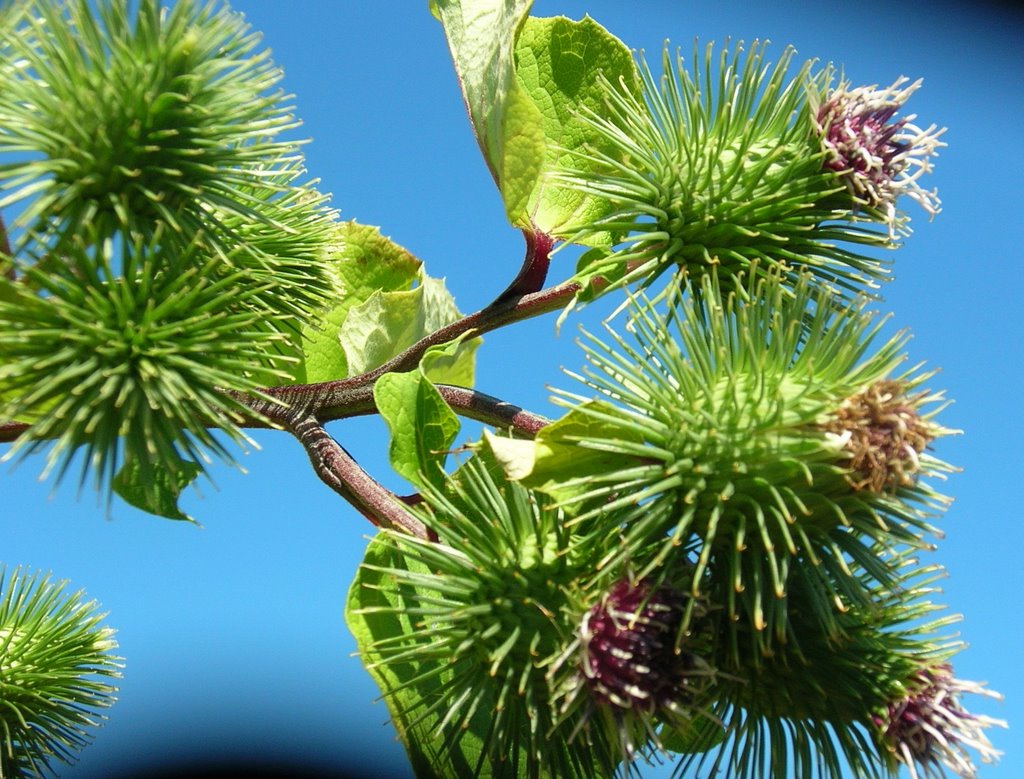 or burdock root. For a liver cleanse regime, burdock root is used in fluid extract or tea form, but for everyday you can also find beautiful long burdock roots (gobo in Japanese) at an Asian grocery store like Uwajimaya, or a natural foods grocery like our Puget Consumers Coop, and include it in your exotic vegetable repetoire. Here is a Japanese recipe I like, which is not a "liver cleanse" recipe because of the oil, sugar, sake and soy sauce (hmm--that's pretty much everything that's in it)
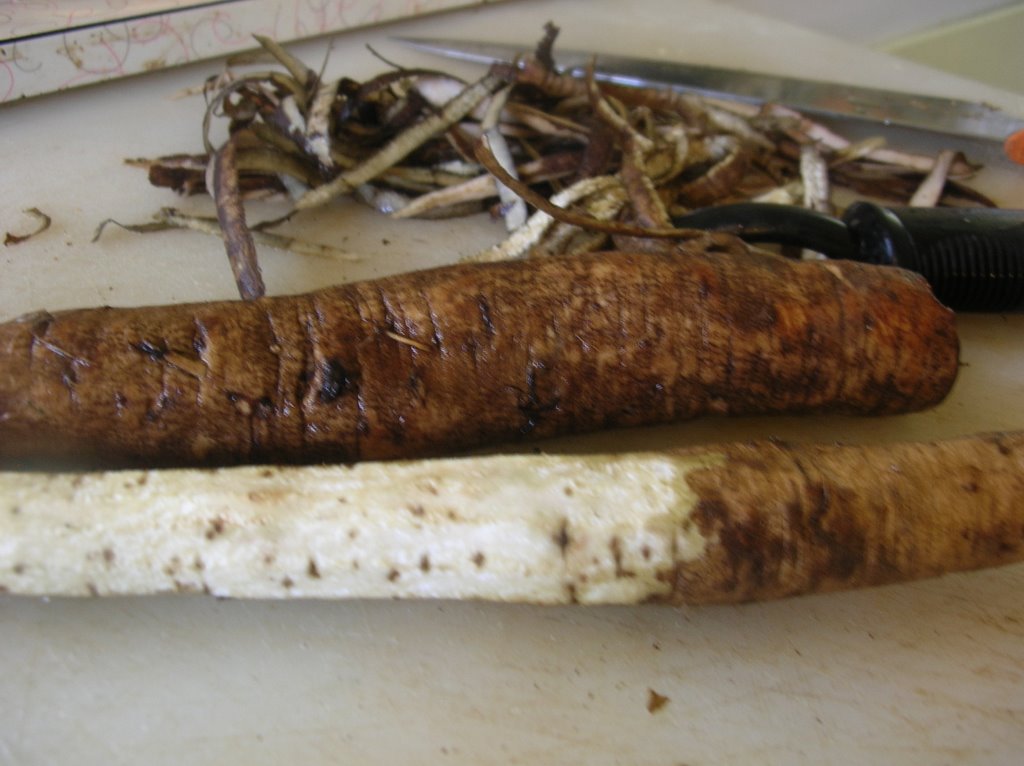 Burdock or Carrot Kinpira (Kinpira Gobo or Ninjin) (adapted from Japanese Cooking, A Simple Art, by Shizuo Tsuji):
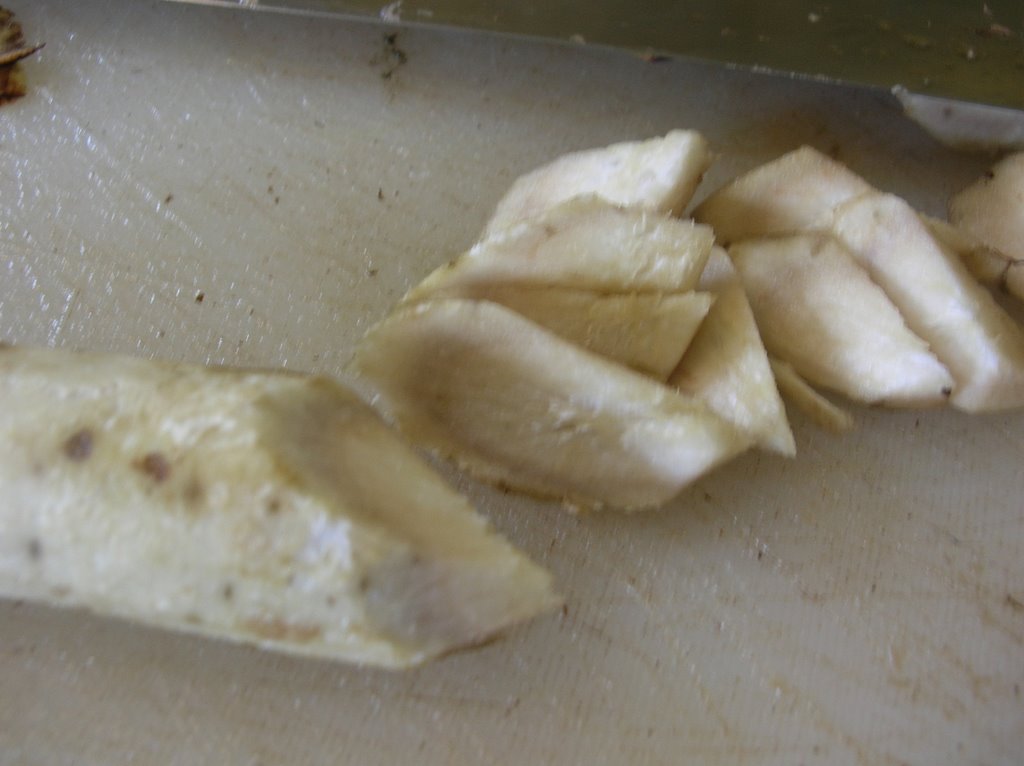 but they are more delicate and not so chewy if you use the shaving method. I like them chewy. Cut the carrots, if using, into julienne or roll-cut them too. To roll-cut, you slice off a piece of the end, at an angle, then roll the vegetable a quarter turn or so, slice off another angled piece, etc. This makes for a lot of the tender & delicious inner-vegetable surface area to hit the hot oil when you get to the stir-fry step, but the pieces are more substantial and interesting than the eqivalent-sized regular slice.
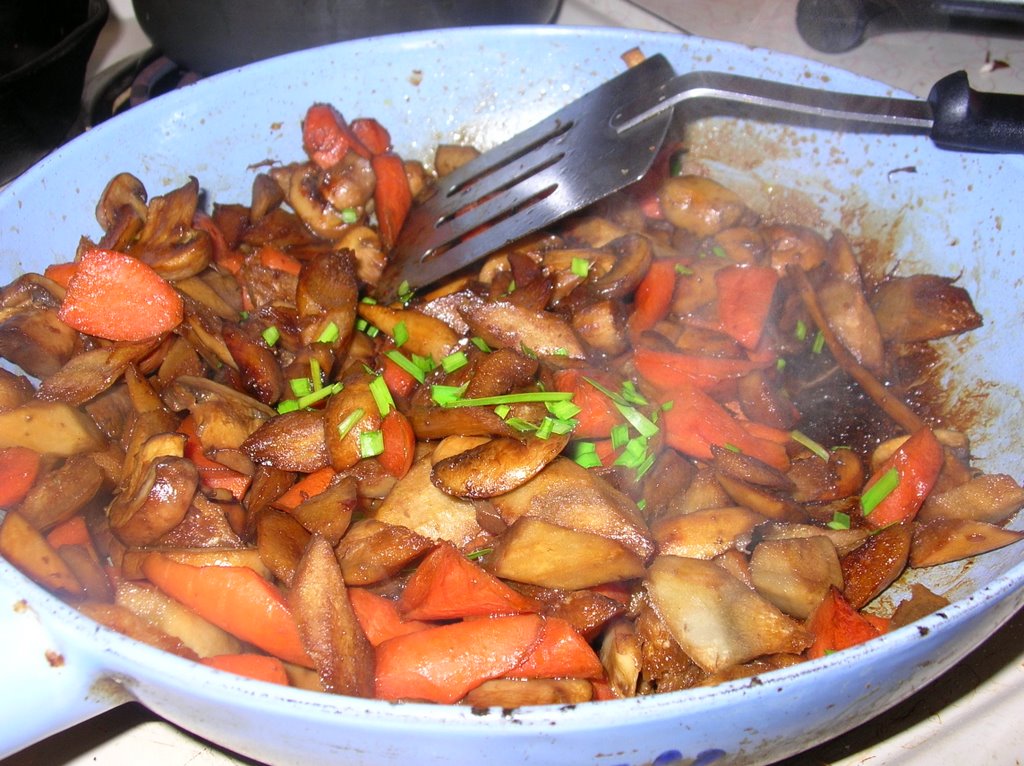 If it sticks and scorches, add a little more sake. Flavor to taste with the red pepper or seven-spice sprinkles.
 Oh, but in the batch that's pictured I also added mushrooms (tasted good, texture was just OK) and I was out of sesame seeds.
Caffeine is time's Viagra.Mark Morford, San Francisco Chronicle columnist, in his Notes and Errata column this week called "Let's All Get ADD! What do coffee, cell phones, the Net, stress and sleep drugs have in common? You, silly" adds,
We equate deranged, caffeinated busyness with smarts, with success, when in fact the exact opposite is true. Just ask the yogis, the gurus, the healers of the past 5,000 years: It is actually when you calm the mind, clear things out, breathe deep and sleep deeper and clean out the toxins and the caffeine and the Ambien, that's when real wisdom, real intuition comes your way. The rest is just, well, noise. Happy delicious annoying caffeinated sexy fun infuriating obnoxious unstoppable noise, but still noise.The amazing and adorable Eric Francis, who is my favorite astrologer, and used to live on Vashon Island near Seattle, but now lives mostly in Paris and sometimes in Brussels, talks about time this week, too, in an essay on the coming lunar and solar eclipses:
But not to worry. They'll soon develop a pill to block that, too.
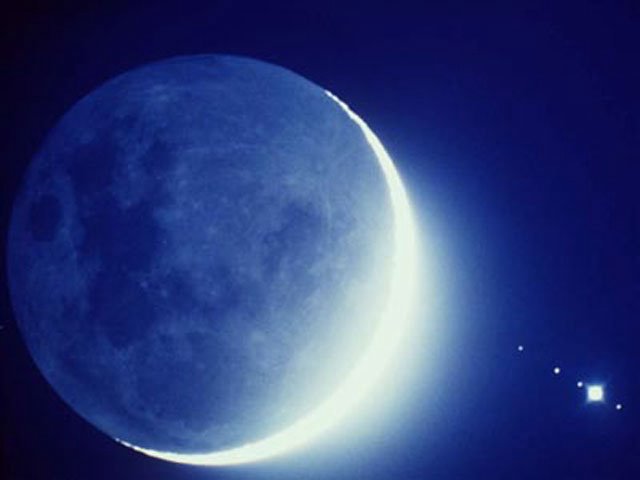
A lunar eclipse presents a nice image of the concentration of time, which we can work with consciously. It begins as a Full Moon. Then, perhaps half an hour later, the Moon is dark; then half an hour after that, it is full again. It's as if we live a month of experience in two hours. But if you consider that the effects of the eclipse radiate out, it's more like we live through the energetic equivalent of a year in a day. Imagine if that actually happened, how disoriented you might feel: going to bed and waking up a year later.
In a sense, we get an antidote to 'speeding time' by pushing the concentration even further. An eclipse is like a massive homeopathic dose of time.
 Thoughtful and provocative new webl, Radical Torah: Sources for the Jewish Social Action Community, "features multiple takes on parshat hashavua (the weekly Torah portion), as seen through the lens of progressive religious and political viewpoints. The project seeks to create a resource of authentically Jewish responses to pertinent social justice issues, timed in accordance with their relevancy to the Jewish calendar."
 Donut, who is also known as Donut-Ponut (lying with her Hedgehog)
Perhaps the greatest archetypal tale in all of human culture about addiction to top-down, unaccountable power is the story of Pharaoh in the Book of Exodus.
Now, today, we are seeing this tale lived out before our own eyes. The present government of the United States has become so addicted to its own power, so swept away by its own arrogance, that it is playing out the tale of Pharaoh.
And the US government is not alone: the present government of Iran is talking like Pharaoh; Al Qaeda acts like a mini-Pharaoh.
Pharaoh begins by hardening his own heart to the plight of the poor and powerless, and after a series of disasters (the "plagues") brought on by his own arrogance, his addiction takes over.
God – read "Reality" – takes over, and from then on it is God Who hardens his heart.
What is this like? — Use heroin once, twice, thrice – and you are making a free choice. But at some point the addiction takes over, Reality takes over, God takes over. Now it is the heroin that is doing you, not you doing heroin.
If you choose hard-heartedness so long you get addicted to it, at some point you are no longer choosing: God, Reality, is hardening your heart.
...Even when Pharaoh's own advisers shriek at him, "You are destroying Egypt!" he can no longer turn back.
Pharaoh has so addicted himself to his own uncontrollable power that he can no longer make a free choice. Unfortunately, when people who have great power insulate themselves in arrogance, the disasters they create do not wound only themselves. They wound the whole society...
Read the rest here.
 This Pillar of Sun, taken in Maine by Lucy Orloski, is from the NASA Astronomy Picture of the Day site
"...You know how a good bass player is just there, in the music, not the main thing but just a continual presence. This dissertation is always there, no matter where I live or what I do for work or how I feel.Congratulations, Jeff! I'm so glad you're inviting us back to cross the rio-grandio with you again!
Okay, so I was working on my dissertation the other day, and I encountered a new reality. Stepped right through the filmiest of barriers to this other side.
I realized that I'm done. This dissertation is done."

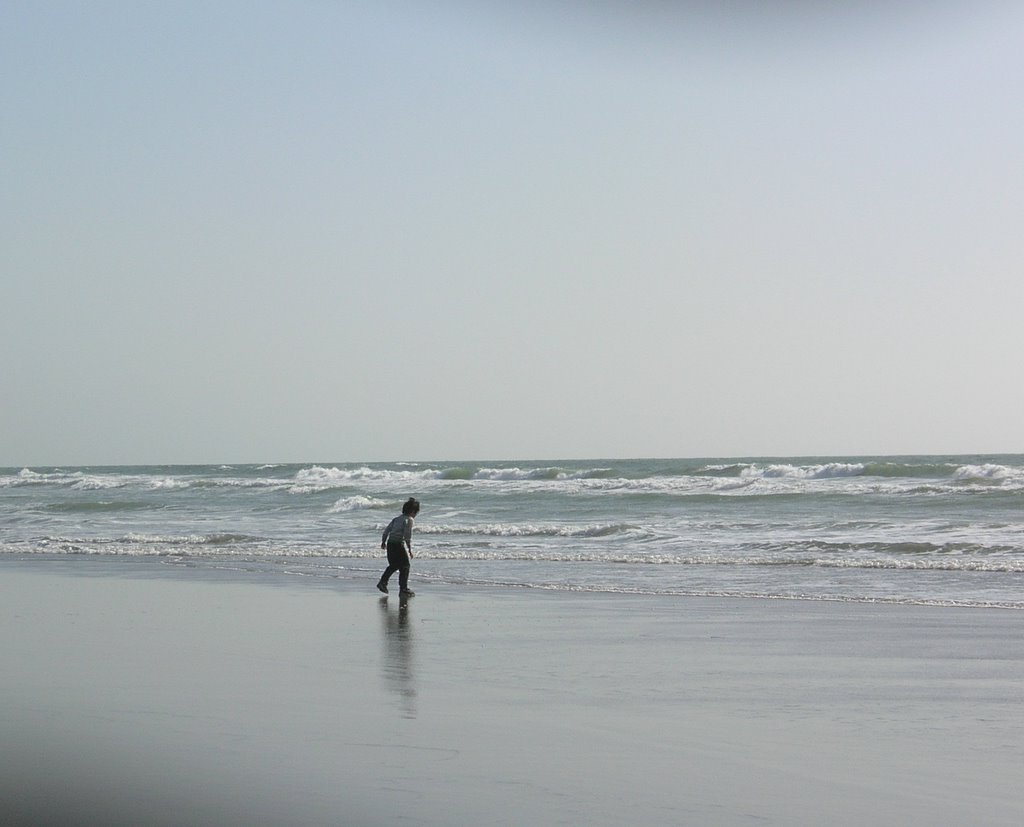 NJ teasing the Pacific
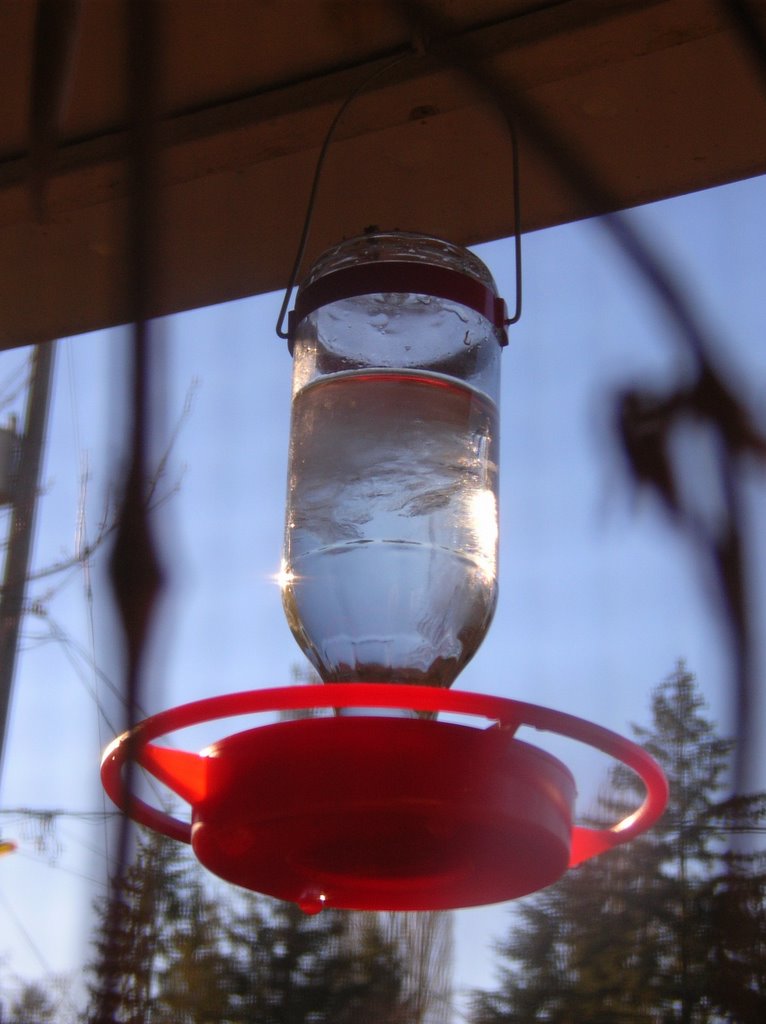 The hummingbird feeder outside our dining room window had ice in it the other day! But only partially, and only till the afternoon. The hummingbirds who live in our neighborhood are the most audible birds around at this time of year, with their chp chp chp chp chp coming from various high-up places.
preparing for liftoff
it is the night of la guadalupana
and each one of a trillion brown oak leaves
(now on the ground) turns
his leathered elder face in a light wind
to face the sky, eyelids closed beneath
the endless black branches of his mother
tree as she swings under the clouds,
each old face awaiting a kiss
from a snowflake, spiraling
downward from the unseen stars,
a gift
for a job well done
posted by chris weaver dec 11 2005
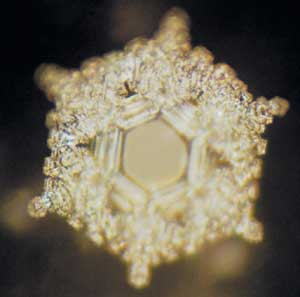
 My friend Emma sent me the link to Stacey Robyn's very sweet Go Gratitude Experiment, a "journey together into the core of Gratitude," which begins with this brief flash video.
"... a wake of Gratitude rolling across our planet, re-connecting our water bodies to Love . Passed person to person, heartbeat by heartbeat, this wake would roll through our bodies - mostly water - to create a massive tide of change by simply focusing on Gratitude."

"...The Zohar says that we are God's name--we're God's verbs, we're God's adjectives, we're even God's dangling modifiers. We're the language of the divine in the world, and in that way, we become the voice of the meshiach--the messiah. Anything less than the realization of that is called, in the inner mystical tradition, heresy. The core liberation teaching of Kabbalah is that to be a heretic is to believe that God does not need me, that I am not required to participate in the evolution of God. But enlightenment means we participate in divinity; we don't just submit to it by responding to the evil and suffering in the world with a traditional theology or a theodicy.The ultimate response to the suffering of the world is, like that of the Hebrew mystic, to cry in protest and to let that protest translate into action. I call this nondual humanism, which means that I participate in God's evolving self, now.
As the great nineteenth-century Hasidic master Nachman of Bratzlav implied, the most important thing in the world is to be willing to give up who you are for who you might become. He calls this process the giving up of pnini, which literally means "what is within." For Nachman, that means the old, familiar thing that comforts even when it no longer serves--and that can include our spirituality and religion, and even the very core way we understand our relationship to the divine ground of being..."
 macchiato,