Sunday, October 16, 2005

pandemic flu, earthquakes, and taking care of each other

(cross-posted to Original Medicine)

Last week was Pandemic Flu Awareness Week, organized by the folks who started the Flu Wiki, which is an international collaborative project aimed at collecting useful information and guidelines to share with communities and individuals for planning and preparing in the event of an influenza pandemic. There is excellent information there on influenza history, epidemiology, immunology, etc., as well as suggestions for public health considerations and areas communities and individuals would do well to consider beforehand.


There was indeed much more information in the news about pandemic flu preparedness (or, in most cases, the acute lack of preparedness so far) than there had been before the collective mind had been put on alert by Hurricane Katrina. King County executive Ron Sims convened a Business Forum on Pandemic Flu in the Seattle area, telling the 75 attendees, “This is the one that keeps me up at night,” and "spoke of 'devastating consequences' and 'extraordinary measures' that will follow when – not if – the avian flu virus mutates to allow human-to-human contact and attacks the globe." There was discussion of, and lots of commentary on, the federal government's preparedness plan (still in draft form, not publically released yet) in newspapers and in blogs.

DemFromCT at The Next Hurrah suggests that "We don't all need to turn survivalist today, but educating ourselves about the potential risks and keeping up with the news is a prudent thing to do. Some preparation efforts will serve you in a hurricane, a blizzard, a blackout or an earthquake. The difference with pandemic flu is that everyone is affected, and that's another thing to keep in mind (you can't expect huge amounts of help from a neighbor state)."

and, writing also at The Daily Kos says, " So what's a reasoned approach? In a nutshell, plan for the worst and hope for the best. All this discussion, this hype, if you will, is designed to teach people that the reality of a pandemic is real and that planning is worthwhile and can save lives. it also should teach everyone in Congress and the WH that having an intact public health apparatus (as my Flu Wiki colleagues the reveres at Effect Measure put it) that it's core public health functions (surveillance, vital records, maternal and child health, substance abuse, communicable disease, immunization, etc., etc.) that have been shafted and need to be built up. First responders are part of that. We should have learned that from 9/11, another teachable moment, but instead funds to support them have continued to be cut."

Such an important part of an "intact public health apparatus" is the strength of community relationships and networks. Remembering that "primary care" and "first response" begin with taking care of ourselves and our friends and relations, at the same time or before we turn to "experts" and "authorities". Knowing our neighbors and neighborhood resources, knowing who might need what kind of support if all the schools and stores and pharmacies are closed for a while.

Also see The Emergency Toolshed at global villages for some good ideas (thank you to Lucas Gonzalez, an Open Space friend and a physician in the Canary Islands, for a lot of this information).

Saturday, October 08, 2005

new spaces

In just this past week, three inviting new spirit-infused community on-line spaces have been opened up:

The Easily Amazed Forum, hosted by Ashley, a place to explore, wonder, notice, exclaim
The Open Space Sangha group blog, hosted by Wendy, "A place to grow our community through sharing practices that deepen our experience of Spirit and Being in Open Space"

And the Bet Alef Meditative Synagogue On-line Community wiki web, a place to share experiences and to deepen our being in touch.

The timing of beginning to invite participation this week is very sweet:

This was the week of Rosh HaShanah, the beginning of the Jewish calendar New Year. "Rosh" means "head", or "beginning," and "Shanah" means "year"--but also, like all Hebrew words, "shanah" derives from a root, a combination of letters that has over time given rise to many words. Each word, then, is a mandala of inner meanings all connected to the root, and one of the root cousins of "shanah" is "shinui" which means "change"; one of the inner vibrations of Rosh HaShanah is Beginning of Change. (thank you to Amy and Olivier for this teaching!)

And astrologically, t's a charged-up time. My favorite astrologer, Eric Francis, writes:

WE ARE IN the interval between two eclipses. Think of it as a hidden valley of time; like a waking dream wherein our actions are more influential and symbolically meaningful, and where we are more impressionable. The intensity of the relationship between our individual minds and our environment shifts to a higher level of intensity, and the decisions we make have greater sway over the course of events. (read the rest here and subscribe here)

Tuesday, October 04, 2005

wildpeace

From Joe at Panhala, a "bonus track" for subscribers, to note Rosh HaShanah, the birthday of the world, and the beginning of Ramadan, a month of special blessing (these potent holydays coincide this year and for the next couple, and then not again for another 30+ years).


What actions are most excellent?

To gladden the heart of a human being.
To feed the hungry.
To help the afflicted.
To lighten the sorrow of the sorrowful.
To remove the wrongs of the injured.
That person is the most beloved of God
who does the most good to God's creatures.

~ Muhammad ~

Wildpeace
Not the peace of a cease-fire
not even the vision of the wolf and the lamb,
but rather
as in the heart when the excitement is over
and you can talk only about a great weariness.
I know that I know how to kill, that makes me an adult.
And my son plays with a toy gun that knows
how to open and close its eyes and say Mama.
A peace
without the big noise of beating swords into ploughshares,
without words, without
the thud of the heavy rubber stamp: let it be
light, floating, like lazy white foam.
A little rest for the wounds - who speaks of healing?
(And the howl of the orphans is passed from one generation
to the next, as in a relay race:
the baton never falls.)
Let it come
like wildflowers,
suddenly, because the field
must have it: wildpeace.
~ Yehuda Amichai ~
(The Selected Poetry of Yehuda Amichai, translated by Chana Bloch and Stephen Mitchell)

Saturday, October 01, 2005

jerusalem is walking in this world

From Julia Cameron's Walking in This World:
This is a great happiness.
The air is silk.
There is milk in the looks
that come from strangers.
I could not be happier
if I were bread and you could eat me.
Joy is dangerous.
It fills me with secrets.
"Yes" hisses in my veins.
The pains I take to hide myself
Are sheer as glass.
Surely this will pass,
The wind like kisses,
The music in the soup,
The group of trees
Laughing as I say their names.

It is all hosannah.
It is all prayer.
Jerusalem is walking in the world.


Monday, September 26, 2005

words, water, plants, the heart, and the breath of god

Slowly reading--well, more like dipping into, being briefly immersed, then emerging and still wet slipping into the next:

Total I Ching: Myths for Change, by Stephen Karcher (thanks to Patrick's mystic scholar friend Steve)
Magic of the Ordinary: Recovering the Shamanic in Judaism, by Rabbi Gershon Winkler (thanks to Jeff Aitken for this and many other wonderful things to know about)
Nourishing Destiny: The Inner Tradition of Chinese Medicine, by Lonnie Jarrett
my "birth portion" in the Torah, which is Eikev

there is some place where these all touch, and I don't think it's too far under the surface.

Assorted snips:

Karcher: "Perhaps the best way to imagine Change is as a stream, a living stream of images, words, emblems and myths that marks the Way of Water, the fundamental image of the Dao. It is a flow of symbols like the images in dreaming. This flow is described as wang lai, going and coming. It is a river of time on which the seeds and symbols of things flow toward us...This Way of Water began in a kind of divinatory practice known all over the world that links water, plants and words."

Torah: "therefore impress these my words upon your very heart; bind them as a sign on your hand and let them serve as a symbol on your forehead"

Winkler: "The tree or grasshopper that you pass as you take your daily stroll, is therefore also the Breath of God. All that exists, is being breathed into being or it wouldn't be. If you are being is'd by the same breath by which the tree is being is'd, then you and the tree are one. Not the same, just one, nurtured into being by the same Breath."

Lonny Jarrett: "In health, these three--the heart, mind, and will--are one. The functions of the mind and will are transparent in communicating the nature of the world to the heart and the nature of the heart to the world. In illness, however, these three functions can be seen to act independently as the will initiates action, ignoring the heart in a vain attempt to satisfy the mind's desires."

Wednesday, September 14, 2005

the season of earth

what does the fruit feel as it ripens, growing sweet and heavy with the juice of the sun?

Tuesday, September 13, 2005

nourishing the fulfillment of destiny

Lonny Jarrett, LAc, will be coming to town next month to teach a continuing education course to acupuncturists. In his book, Nourishing Destiny, The Inner Tradition of Chinese Medicine, he says,

"A basic premise of Chinese medicine is to move stagnation before tonifying and there is no greater stagnation in life than having forgotten one's true self. Thus we recognize that nourishing the fulfillment of destiny is the heart and soul of our medicine."

"...Another hallmark of the inner tradition is that it explicitly serves as an extension of the practitioner's own spiritual quest and path. A foundational princiople of this tradition is that a practitioner may only engender a virtue in a patient to the degree that he or she is able to access that virtue within."

Sunday, September 04, 2005

helping enrich the field

Michelle and Joel Levey, radiant and soulful friends and mentors, will be two of about 60 professional facilitators working to support the interactive conversation portions of the inaugural meeting of the Clinton Global Initiative in New York Sept. 15-17.

From the statement of mission by President Clinton:
"...This nonpartisan conference will concentrate a diverse and select group of current and former heads of state, business leaders, noteworthy academicians, and key NGO representatives to identify immediate and pragmatic solutions to some of the world’s most pressing problems. The workshops will focus on how to reduce poverty; use religion as a force for reconciliation and conflict resolution; implement new business strategies and technologies to combat climate change; and strengthen governance. Our meeting will emphasize dynamic group interaction to identify an agenda we can actually implement.

By identifying specific ways to address the challenges of our time and asking each participant to make a specific commitment to take action in one of the areas discussed, I believe this Initiative will prove to be a unique and effective forum for leaders and their communities around the world. What we begin during three days this September will continue throughout the year to come with coordinated implementation of our agenda..."

and,
"In my life now, I am obsessed with only two things: I don’t want anybody to die before their time. And I don’t want to see good people spend their energies without making a difference…You can change the reality of human history by systemic action."

The coordinator of the facilitator group, Ruthann Prange, sent this request to subscribers of the Collective Wisdom Initiative listserv:
"If you are drawn to look at the website you'll see the issues being addressed (poverty, religion, climate change, governance) and the invited participants from around the world would certainly be well served by the wisest available collective intelligence. So please send your strongest signals our way on the 16th and 17th, help enrich the field in which the conference participants will be working. And help those of us physically present to BE present, intentional about holding the space, and freed from our personal advocacy positions so that we can support emergent collective intelligence.

Saturday, September 03, 2005

"the beginning of the end?"

Michael Herman writes:
"...If 9-11 made it all too clear that we are actually part of the rest of the world, Katrina (if not already Iraq) will teach us that we are not in control of much of it.

The only solution must be an active cultivation of individual, personal and direct responsibility and contribution. Everybody pays attention. Everybody helps out. Everybody is responsible for getting and keeping themselves out of danger. And everything that the federal government does is gravy.

And to be clear, I don’t see this as a step back, but a step forward for us all, albeit a long and difficult one to make. Or maybe it’s a very short one. What can you do? Who do you know? ...

We’re all in this together. And last I checked, despite the wobbling, we are still a democracy, which means we are the federal government. All of us. Let’s get it in session! …and get it in gear! This end must be our beginning."

From my little viewfinder, I see our clinic's health-care approach as a companion trail to Michael's track forward--we think of "self-care as true primary care," along with taking care of each other, our family and friends and community. As that (when that? if that?) becomes the norm, then our role as health-caring professionals could be much more of a supportive role, much more education-oriented, our strongest interventions needed much less frequently. The kinds of things we so often do now--our diagnostics and treatments of situations that could have been prevented by "paying attention" and "active cultivation of individual, personal and direct responsibility and contribution" --could be gravy, too. (Or dessert) One little piece of the compelling call to learn and practice personal responsiblity and contribution.

Thursday, September 01, 2005

http://www.hurricanehousing.org

My friend Victor shared a story from his colleague, Debra, who lives in Texas:
"We moved to Austin from New Orleans last year so we have many, many ties to the folks there. Some of the poorer inner-city kids that I taught in New Orleans called me and told me that four families pooled their money and their two cars and just drove as far as they could go until their money ran out. Only one person in the two cars had ever been out of New Orleans before. Lost, stranded, no money, scared and no homes to return to. The scope of their pain is more than I can even understand.

I am trying to make my home open to as many as I can. I think that one of the best things that folks can do is to "adopt a family" and share their homes. There will be literally hundreds of thousands of folks who are now homeless, jobless, and isolated from friends, family and all support systems."

MoveOn.org
has organized a housing share connection project:
Tens of thousands of newly homeless families are being bused to a stadium in Houston, where they may wait for weeks or months. At least 80,000 are competing for area shelters, and countless more are in motels, cars, or wherever they can stay out of the elements. The Federal Emergency Management Agency and the Red Cross are scrambling to find shelter for the displaced.

This morning, we've launched an emergency national housing drive to connect your empty beds with hurricane victims who desperately need a place to wait out the storm. You can post your offer of housing (a spare room, extra bed, even a decent couch) and search for available housing online at:

http://www.hurricanehousing.org

Housing is most urgently needed within reasonable driving distance (about 300 miles) of the affected areas in the Southeast, especially New Orleans.

Please forward this message to anyone you know in the region who might be able to help.

Wednesday, August 31, 2005

filling a bowl with water

Today is my day off, and waking early, I feel myself seeping full to overflowing (spilling now into this keyboard and then onto this page) thoughts and questions and things to do, filling any space opened during brief yoga and morning tea: remembering something I want to get for my husband for his birthday which is tomorrow, coordinating picking up and dropping off my sons who are getting together as often as possible with their friends in these last few days before school starts, getting together myself with friends I used to work with at the Bastyr clinic, for "high tea" at the ornate Victorian tea parlor. Planning for a practitioner meeting at my current clinic at lunchtime, and calling in supply orders and a CT scan order that I faxed last night that apparently didn't go through. Catching up on reading, evocative articles and essays , blog and listserv and forum posts, noticing I am not reading every word but skimming and buzzing through (hmm, am I even breathing while I read?). In the background, feeling live wires sizzling and waving and seeking to connect all the thoughts and questions.

And then sitting down with the newspaper and seeing New Orleans under water, a city nestled in a bowl filling with water. Sitting, then; my own small sense of over-brimming in perspective, now. Sending blessings, and money (I like the American Red Cross). More blessings.

Lots of blogging people are gathering resources and connecting and organizing information to help in a variety of ways (these links thanks to Nancy White).

Wednesday, August 24, 2005

sacred advertisements and dionysian manifestos

A couple of random selections from my current favorite book, Pronoia is the Antidote for Paranoia: How the Whole World is Conspiring to Shower You with Blessings, by rock-star-astrologer "aspiring master of curiosity, sacred janitor and macho feminist" Rob Brezsny and the Beauty and Truth Laboratory:
"HYPOTHESES: Evil is boring. Cynicism is idiotic. Fear is a bad habit. Despair is lazy. Joy is fascinating. Love is an act of heroic genius. Pleasure is our birthright. Receptivity is a superpower."

"Dear Gorgeous Genius

While you and I are together here:
Your favorite phrase is flux gusto
The colors of your soul are sable vermilion, ivory and jade

Your magic talisman is a thousand-year-old Joshua tree whose flowers blossom
just one night each year and can only be pollinated by the yucca moth
Your holiest pain comes from your yearning to change yourself in the exact way
you'd like the world around you to change
Your soil of destiny is peat moss
Your mythic symbol is a treasure chest dislodged from its hiding place
in the earth by a flood
Your lucky number is 13 to the 13th power
Your sweet spot is in between the true believers and the scoffing skeptics
A clutch of frog eggs from an unpolluted river is your auspicious hair-care product
The anonymous celebrity with whom you have most in common is the jester
who followed Buddha around and kept him loose
The question that perks you up when your routine becomes too rote is this:
What possesses the bar-tailed godwit to migrate annually from Alaska to New Zealand
by hitching rides on gale-force winds?"

Lots more, of all kinds, here.

Saturday, August 20, 2005

what remains


The temple bell stops ringing
but the sound keeps coming out of the flowers

~Basho

Saturday, August 13, 2005

global voices

From one of the originators of the very rich, illuminating, mind & heart-expanding Global Voices, which posts blog entries and photos drawn from dozens and dozens of blogs all over the world in order to "diversify the conversation taking place online by involving speakers from around the world, and developing tools, institutions and relationships to help make those voices heard":
...I come out of my day's worth of research with a sense that Global Voices is working, in a deep, profound way. Two of our major goals when we started the project this past December: create a space for global conversation, and have an influence on the existing blogosphere, ensuring that blogs aren't just about US politics and technology. That blogs from 35+ countries and almost a dozen languages are pointing to us suggests that we're starting to create a global space; that Blogpulse thinks we're one of 200 of the most cited blogs suggests that we're starting to have that influence on the blogosphere. It's not unreasonable to image that we might be one of the hundred most cited blogs by the end of 2005, a goal that would probably have a truly transformative effect on the blogosphere as a whole.

Thanks to everyone who's linked to, read or been influenced by the links Global Voices has posted over the past six months. Please keep tuning in. We really do intend to change the world of blogging to make it more global, more interconnected and more diverse... and so far, we're doing it. --Ethan Zuckerman

Wednesday, August 10, 2005

sufi rock stars

In the latest issue of What Is Enlightenment? magazine there is a short article about a hugely popular Indian-Pakistani-American rock band, Junoon, and one of their guitarists, Salman Ahmad. Ahmad was "the rock star" in a BBC documentary program called The Rock Star and The Mullahs, filmed in Pakistan's North West Frontier Province, where public music has been banned and musicians harassed. A Sufi Muslim, Ahmad's question to the radically fundamentalist clerics: "Where in Islam does it say that music is forbidden?"

Here you can listen to some of Junoon's songs
(I especially like "Taara Jala" and "Ghoom Taana") and hear why they were called "the U2 of Asia" by the NY Times.

Tuesday, August 09, 2005

knots of silk

This time of the summer is always teeny tiny spider time in my yard. Sometimes we find them in the house and toss them back outside.

Teeny spiders make me think of this breathtaking passage from David Abrams'
The Spell of the Sensuous, as he describes being in a lushly mossy little cave, refuge from a tropical torrential downpour in a valley in Bali:

"Soon I was looking into a solid curtain of water, thin in some places, where the canyon's image flickered unsteadily, and thickly rushing in others. My senses were all but overcome by the wild beauty of the cascade and by the roar of sound, my body trembling inwardly at the weird sense of being sealed into my hiding place.

And then, in the midst of all this tumult, I noticed a small, delicate activity. Just in front of me, and only an inch or two to my side of the torrent, a spider was climbing a thin thread stretched across the mouth of the cave. As I watched, it anchored another thread to the top of the opening, then slipped back along the first thread and joined the two at a point about midway between the roof and the floor. I lost sight of the spider then, and for a while it seemed that it had vanished, thread and all, until my focus rediscovered it...Whenever I lost the correct focus, I waited to catch sight of the spinning arachnid, and then let its dancing form gradually draw each new knot of silk as it moved, weaving my gaze into the ever-deepening pattern.

And then, abruptly, my vision snagged on a strange incongruity: another thread slanted across the web, neither radiating nor spiraling from the central juncture, violating the symmetry. As I followed it with my eyes, pondering its purpose in the overall pattern, I began to realize that it was on a different plane from the rest of the web, for the web slipped out of focus whenever this new line became clearer. I soon saw that it led to its own center, about twelve inches to the right of the first, another nexus of forces from which several threads stretched to the floor and ceiling. And then I saw that there was a different spider spinning this web...The two spiders spun independently of each other, but to my eyes they wove a single intersecting pattern. This widening of my gaze soon disclosed yet another spider spiraling in the cave's mouth, a
nd suddenly I realized that there were many overlapping webs coming into being, radiating out at different rhythms from myriad centers poised--some higher, some lower, some minutely closer to my eyes and some farther--between the stone above and the stone below.

I sat stunned and mesmerized before this ever-complexifying expanse of living patterns upon patterns..."

This is the image that came to my mind also when Dan Leahy and I chatted recently about all the professional + personal networks of conversation and practice and collaboration and collective exploration that we know about or are involved with, and how we might imagine them visually or map them. Of the several models that we have played with--geodesic dome with glowing nodes, living cells in organic or organismic relationship, a fluid territorial map where any two or more spots can be become instantly contiguous, and others--I am drawn to Abrams' powerfully-related experience of the spider world, to see it as a metaphor for all of the many kinds of world-soul restoration work that's being done everywhere I look. I love the sense of incredibly complex beauty and order that arose from the independent spinning of each individual spider, overlapping (and intersecting?), each web originating from its own center and radiating outwards. I enjoy my own anthropomorphic interpretation, as an aspiring web-spinner, that we can relax into trust, and rely on each other to come from our own centers to create an inevitably perfect and "ever-complexifying expanse of living patterns..."

Monday, August 08, 2005

good birthday poem

Another from the wonderful Panhala listserv, poetry matched with photos of nature and a music clip:

There is No Going Back

No, no, there is no going back.
Less and less you are
that possibility you were.
More and more you have become
those lives and deaths
that have belonged to you.
You have become a sort of grave
containing much that was
and is no more in time, beloved
then, now, and always.
And so you have become a sort of tree
standing over the grave.
Now more than ever you can be
generous toward each day
that comes, young, to disappear
forever, and yet remain
unaging in the mind.
Every day you have less reason
not to give yourself away.

Wendell Berry
A Timbered Choir: The Sabbath Poems 1993, I

Sunday, August 07, 2005

angel jazz

My friend Brad took me to Dimitriou's Jazz Alley to hear the genius liquid-angel-jazz guitar playing of Stanley Jordan. Stanley uses an old and still relatively unusual technique called "touch" or "tapping," his hands on the neck of the guitar the whole time, touching the guitar strings with his fingers flat, so that his dynamics are as agile and intricate as they could be on a keyboard. His beautiful and lush arrangements incorporated separate melodic lines for right and left hands, making music that sounded like it was being created by two, or three, virtuoso guitarists. Along with his own jazz compositions, he also played pieces by Mozart, Debussy, Beethoven, as well as amazing renditions of O Holy Night, and Hava Nagila! His CD "Ragas", which includes musicians on sitar and tablas, playing Indian classical music--improvised within a form, just as jazz is--is gorgeous.

Sunday, July 31, 2005

"useless" praise


Word for the Day from Gratefulness.org
The more alert we become to the blessing that flows into us through everything we touch, the more our own touch will bring blessing.

Brother David Stendl-Rast

Thursday, July 21, 2005

summer in the garden


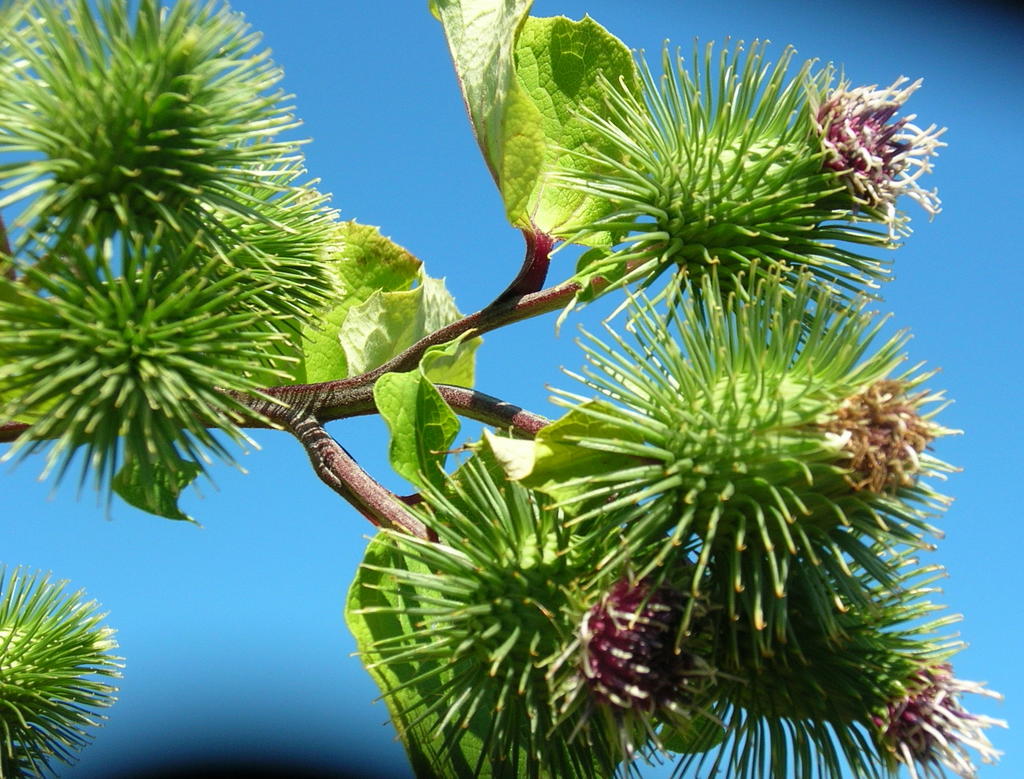
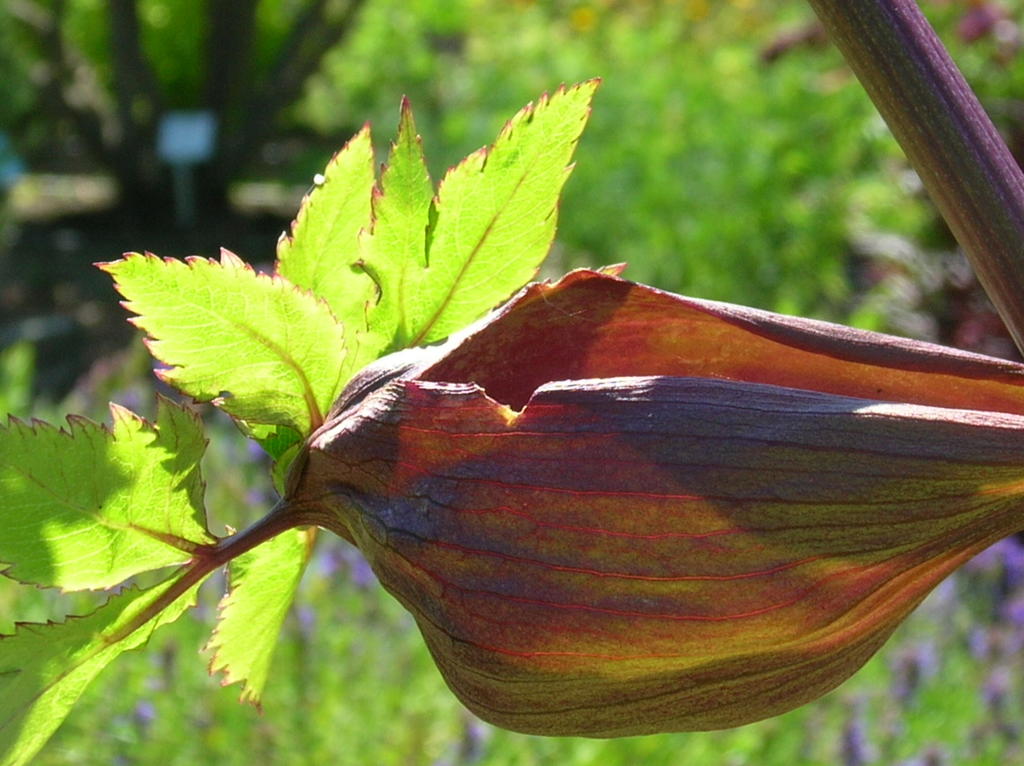
Some of denizens of the medicinal herb garden at Bastyr University (top is Arctium lappa/Burdock and bottom is Angelica archangelica)

basil for breakfast

Chris W replied to my email this morning, saying,

"i have cooking metaphors coming to me. i think i'll write a poem:

isn't every cook
a culture of her own,
how she knows mushrooms,
how she knows salt,

the lifelong gathering
of living ingredients, each one
its own astounding self, each one
a culture of its own, yet
in her hands
an ingredient

(ingredient is not a beautiful word
until i decide to make it so
by imagining a sprig of seven basil leaves
in your hands)

the other day i met someone
who cooked with many of my ingredients
in a completely different way
because her living had taught her stories
about what comes before and what comes after
the time of cooking, stories
i had not lived or seen or been taught before

and i let myself be a dry sponge
in the curious clear waters of her ways
and, delight of delights,
she experienced me the same way:
(wow, yes, look what you do, look how:
a way that no one ever taught you, your own
accumulation of ways, so precise to yourself)
so we're bartering mentoring time
hanging out in one another's kitchens
not a moment too soon, as we are called
to do our thing at the big ceremonial feast
whose wild glow is visible in the night sky
over the next small ridge"

all the ways home


"Dig anywhere deeply enough and it will take you Home"


~My friends Joel Levey, PhD and Michelle Levey, MA, during their presentation to our "CAM camp" students on Meditation and Healing, about the infinite variety of spiritual paths.

Sunday, July 17, 2005

kingdoms of resonance

Homeopathic medicines are infinitesimal and potentized dilutions made from just about any substance medicine-makers can get their hands on (including plant, mineral, animal, microbial materials) and some that they can't (moonlight, X-ray radiation). Just as with any medicine, there are commonalities amongst remedies that are derived from related substances. Categories such as the Plant, Mineral and Animal Kingdom remedies have some broadly distinguishing traits and patterns--and theory is that the patterns and themes of a particular substance are reflected in the physical symptoms, personality characteristics, the world-view, even the dreams, of a person who would benefit from the medicine made from that substance. I don't know what my homeopath friends would prescribe for me these days--in the past I've benefitted from two remedies that derive from sea creatures...but one is categorized as a mineral, because it's the shell that's potentized, and the other is categorized as an animal remedy. You can read some interesting notes about remedies made from sea animals here.

Bombay master homeopath and physician Rajan Sankaran has said that in this time of great extinction, the essence of the animals and plants that are disappearing is showing up more and more in human beings.

Another expression of the way humans and the "more-than-human" world reflect one another: one of the enchanting aspects of the world created by Philip Pullman in his series of books, called His Dark Materials, is that every human being there is born with a "daemon", an aspect of their soul who appears in animal form, inseparable from the person, their visible essence. (Another enchanting aspect is the two male angels who adore each other and have been together for eons.) The daemon plays with changing from animal to animal all through childhood, and then at puberty settles into the right stable form. Pullman says (in the interview linked to above) that a person can't choose what their daemon is; and for us here, who can't (usually!) see our own, we have to ask others who know us to tell us what ours is.

And then, there is our own internal resonance. A homeopath might match me to one aspect of this world, and in Pullman's world I might cleave to another aspect; in my own imagination, I feel most at home in the kingdom of the plants. And I'm pretty sure that if I were a plant, I would be a vine. One of those vines that climbs up things with curly tendrils towards the sun, and sprawls into all of the available space and slides between and into other plants, and flings out new growth when it's whacked back to the roots. Oh, and has flowers that attract hummingbirds!

The vines I have in my small yard: red honeysuckle, clematis (5 kinds), wisteria, two kiwis (a fuzzy male and smooth female), passionflower, jasmine, cardinal creeper (and usually I have annual morning glories and cup-and-saucers and sweet peas, but I didn't get around to planting them this year), and unfortunately there is also perennial morning glory (otherwise known as bindweed). And in the house I have two hoya carnosas (the photo at the top is the silhouette of one of my hoyas, when it was in my office).

Here is my friend and relation, the passionflower (Passiflora caerulea) out on the deck behind our house:


Tuesday, July 12, 2005

world o' books

Andy sent me this fun thing to do, a consideration of books in my life. Because the set of questions is being sent on from blog-person to blog-person, it's kind of like a chain letter, or a contagious virus; or like a game of tag. (I guess "technically" it's called a "meme" which is "an idea or behavior that spreads through a culture" and which seems to be related to "mimic" and to the French word for "same" which is "meme" with a little accent over the first "e" which I don't know how to type in Blogger-text.)

I think it is also an opportunity for rediscovery and praise, as well as a very good way to avoid tackling the piles of work spread all over the dining room table (I've even managed to accumulate a pile of stuff to do under my laptop).

How many books I've owned
I would be surprised if anyone I know who is over the age of 6 knows how many books they own. Just lots, and lots. Lots. Even after selling big boxfuls and giving piles away. I do love and appreciate the Public Library system, but I can't write in those books. Once I have a relationship with the ideas or fall in love with any of the phrases or passages, I want to have my own copy so that I can write back, in the margins.

Reading style
During spare moments, and at night. My husband and sons and I take our books with us when we go to restaurants, and if we're not talking, then we're reading. I always have a magazine or journal or article to read in my briefcase, and always take a book (sometimes just a blank book) when I'm carrying a backpack or purse. I also often read in the hottub. So, my books not only have handwriting and drawing in them, they often have water spots too (I don't do those things to books I borrowed, though, honest!)

The last book I bought
Mediated: How the Media Shapes Your World and the Way You Live In It by Thomas de Zengotita, on the recommendation of Toyce at the Integral Education Center. I haven't started it yet--it's in the "next" pile.

The last book I read
Hmm. I guess that means the last book I actually finished. There are many many books on the floor or on my desk or in one of my bags that I have read part of and then put down, either for a while, or for pretty much ever.

So, the last book that I read all the way through (and didn't even skip the boring parts because there weren't any) is called Field Notes on the Compassionate Life: A Search for the Soul of Kindness, by Marc Ian Barasch. He explores the nature of human (and animal) compassion and altruism from the perspectives of neuroscience, spiritual teachings and practice, psychology, evolutionary theory, and through interviews with people who have forgiven unthinkably horrible crimes, and with people who have gone way out of their way for total strangers, wondering: what is the essence of compassion? Can it be learned? Is kindness counter-evolutionary, or the ultimate evolutionary force?

It's written in a personal style that in itself is elevating. Here's a bit:
"Something within us already conduces toward heartfulness, and its nature is to grow with the merest effort. Aldous Huxley, asked on his deathbed to sum up what he had learned in his eventful life, said, "It's embarrassing to tell you this, but it seems to come down mostly to just learning to be kinder." And though I set out to write a more hardheaded, less softhearted (and perhaps les softheaded) book, I can onloy conclude the same.

People living in arid countries have found a simple method of collecting water. They spread out sheets of fabric at night and siphon off the dew that condenses on them each morning. Like moisture, love really is in the air. It will settle upon the thinnest reed, scintillate on a bare tip of grass, free for the taking. It is an elixir that can heal, drop by drop, all the sorrow and separation in the world. It changes pretty much everything."
Five books that mean a lot to me
Pilgrim at Tinker Creek, by Annie Dillard
Coming to Life: Traveling the Spiritual Path in Everyday Life, by Polly Berrien Berends
The Spell of the Sensuous: Perception and Language in a More-Than-Human World, by David Abram
The Jew in the Lotus: A Poet's Rediscovery of Jewish Identity in Buddhist India, by Rodger Kamenetz
His Dark Materials (a trilogy that includes The Golden Compass, The Subtle Knife, and The Amber Spyglass), by Philip Pullman

I love the language and the ideas and the perspectives of all of these books so much, and don't think I can describe then well enough to even try.

(And these are the books I'm reading now--a new category that wasn't in the original recipe...)
Principles and Practice of Phytotherapy: Modern Herbal Medicine by Kerry Bone and Simon Mills
The World Cafe: Shaping Our Future Through Conversations that Matter, by Juanita Brown with David Isaacs
Jerusalem: One City, Three Faiths, by Karen Armstrong
Consciousness & Healing: Integral Approaches to Mind-Body Medicine, edited by Marilyn Schlitz and Tina Amorok with Marc S. Micozzi

Invite some more to play
I'll see if Open Space friends Ashley, Chris, Jeff and Michael, and new-to-blogging, long-time-friend, Brad, are interested--particularly, of course, I'd like to know what their "books that mean a lot to me" are, so that I can read them,too.

Sunday, June 26, 2005

intensified sky

Ah, not to be cut off
not through the slightest partion
shut out from the law of the stars
The inner -- what is it?
if not intensified sky,
hurled through with birds and deep
with the winds of homecoming.

~Rainer Maria Rilke
Ahead of All Parting: The Selected Poetry and Prose of Rainer Maria Rilke
translated by Stephen Mitchell

Saturday, June 25, 2005

the lord god bird

Chris wrote quite a while ago (I have a lot to catch up on) about the re-discovery of the Ivory-billed Woodpecker (who's been dubbed "Elvis") in Arkansas under the title "Never give up on anyone".

Because of his post, I noticed and read the little article in our local Audubon Society newsletter that pertained, called "If It Doesn't Want to Be Found, How Do We find It? And How Many More are Out There?". Dr. James Van Remsen, curator of ornithology at the LSU Museum of Natural Science, writes the following about trying to verify a sighting in the Pearl River swamp in Lousiana in 1999 (the last verified U.S. sighting, before the one this past April, was in the 1940's!):
"We conducted that search with the cocky attitude that, regardless of how wary, Ivory-billed Woodpeckers would make enough noise (calls, double-raps, or bark-scaling) that our black-belt field commandos would find them just by getting within earshot. That attitude comes from plenty of experience with other rare and hard-to-find birds. Hard to see, yes, but nonetheless always revealing themselves by sounds to those who tune in. However, if Arkansas Elvis is any indication, we could have missed dozens of birds in the Pearl. Elvis is not only incredibly wary, seldom allowing more than a glimpse before flying off not to be relocated, but astoundingly quiet. If our birds behave like this, finding them wil require the stealth skills of a turkey hunter...It is tempting and perhaps reasonable to speculate that the last Ivory-billeds, under intense hunting pressure from humans, survived only because of the behavioral changes required to regard humans as deadly. If ducks and turkeys can develop such behaviors seasonally, longer-lived and probably smarter big woodpeckers could get this way fast."

Tuesday, May 24, 2005

convergence

Wow. I began this post many weeks ago, and haven't had time to revisit it till now. Too much converging to fill my days to overflowing.

(Which brings to mind a movie I was meaning to see, called Short Cut to Nirvana --do watch the trailer!--about the mammoth Kumbh Mela festival, a convergence of 70 million people at the place where the Ganges and Yamuna rivers converge, every 12 years. Well, and, that's just it: big convergence, not quite enough time to get to everything I've been meaning to get to, and every single thought and conversation reminding me of something or someone interesting and/or important.)

Alternately, I have felt for the past few months as if I am carrying around, or wearing, a big heap of threads and fuzzy strings. They're multicolored, bright and dark, a little tangled where their unraveled edges catch, and weaving themselves into strange patterns and textures when I'm not watching. Lately I've gotten to toss some of them into the center of various circles of comrades, colleagues & friends, and then I always find myself coming home with even more than I started with!

Some of the streams/threads:
Business: dissolving one and creating another one, all at the same time; the dozens (maybe hundreds!) of practical and logistical details (because we're also moving our practice location), as well as all the karmic and energetic ties we leave, and the new ones we generate.

Teaching, learning: & their relationship to hosting and inviting, to opening space for passion and responsibility in the midst of a very linear, accreditation-shaped curriculum; the notion of integral education; the "teacher formation" work originated by Parker Palmer.

Opening space for giving, receiving, flourishing (and teaching and learning...) (link to be invented soon) and the Open Space Practices that Michael & Chris are languaging & polishing

Torah: learning to read Hebrew, along with the mystical interpretations of each letter, experiencing more and more Rabbi Ted's intersection of mystical (the path of perceiving underlying radical inclusiveness) and prophetic (the call to social justice mandated by that perception) Judaism and the community that has grown, and continues to grow, around that intersection.

Medicine: working with the area of the "determinants of health"--those conditions that allow for optimal health to be realized (or not)-- because it's only partially useful to alleviate/palliate someone's anxiety or exhaustion or insomnia or neck pain when it springs from their reaction to the current state of our culture and of the world (and sometimes it's actually suppressive to do that.) Even with "natural" methods rather than anti-depressants. How, instead, to vitalize that reaction to support participation in healing of society & culture, and ecological healing?

And these are some of the books I'm reading, which somehow also seem to be converging (though I have no idea how, yet...)

Field Notes on the Compassionate Life: A Search of the Soul of Kindness by Marc Ian Barasch
Blink: The Power of Thinking Without Thinking by Malcolm Gladwell
A Hidden Wholeness: The Journey Towards an Undivided Life by Parker Palmer
Getting Things Done: the Art of Stress-Free Productivity by David Allen
and re-reading: The Four-Fold Way by Angeles Arrien

OK. Time to fill the hummingbird feeder and deadhead the rosebush. Or, take a nap!

Tuesday, April 19, 2005

leaves as pages in a secret text

Here is another Edward Hirsch poem, courtesy of the wonderful poetry subscription list Panhala, which I learned about thanks to Andy.

Poet, essayist, literary critic, English professor, Edward Hirsch is currently president of the John Simon Guggenheim Memorial Foundation, and is the author of two of my favorite books, How to Read a Poem and Fall in Love with Poetry, and The Demon and The Angel: Searching for the Source of Artistic Inspiration

I Am Going to Start Living Like a Mystic

Today I am pulling on a green wool sweater
and walking across the park in a dusky snowfall.

The trees stand like twenty-seven prophets in a field,
each a station in a pilgrimage--silent, pondering.

Blue flakes of light falling across their bodies
are the ciphers of a secret, an occultation.

I will examine their leaves as pages in a text
and consider the bookish pigeons, students of winter.

I will kneel on the track of a vanquished squirrel
and stare into a blank pond for the figure of Sophia.

I shall begin scouring the sky for signs
as if my whole future were constellated upon it.

I will walk home alone with the deep alone,
a disciple of shadows, in praise of mysteries.

(From Lay Back the Darkness)


Wednesday, April 06, 2005

uncertainty

We couldn't tell if it was a fire in the hills
Or the hills themselves on fire, smoky yet
Incandescent, too far away to comprehend.
And all this time we were traveling toward
Something vaguely burning in the distance --
A shadow on the horizon, a fault line --
A blue and cloudy peak which never seemed
To recede or get closer as we approached.
And that was all we knew about it
As we stood by the window in a waning light
Or touched and moved away from each other
And turned back to our books. But it remained
Even so, like the thought of a coal fading
On the upper left-hand side of our chests,
A destination that we bore within ourselves.
And there were those -- were they the lucky ones? --
Who were unaware of rushing toward it.
And the blaze awaited them, too.

Edward Hirsch
from Earthly Measures (Knopf, 1994)

that which connects

I sat in the hot tub in our rainy backyard the other morning, with my computer wrapped in two towels against the drizzle, and listened to an a conversation between philosopher Ken Wilber of the Integral Institute and Reb Zalman Schacter-Shalomi (grandfather of the neo-Hassidic Jewish Renewal movement). You can download here it from Integral Naked if you become a subscriber (the first month of subscription is free!).

At one point Wilber says: "Buber talked about the I-Thou relationship--and the Big Mystery is that hyphen."

Sunday, March 27, 2005

moleskine

I am in the habit of carrying around a blank book and using it to write down anything I might want again later (impressions, phone numbers, thoughts, dreams, notes from lectures and meetings and conversations, phrases I like, an occasional striking shape or contour) (but not appointments--those go on the calendar; and no grocery lists--those go on a scrap of paper destined inevitably to be lost somewhere after the produce section and before the cereal aisle).

I fill it up in the order of things received, till I get to the end, and then I get a new book that looks different from the previous one. I know which part of my life, which months, are in the yellow book with the calligraphy on it, which part is in the book with the red rubbery cover imprinted with a Chinese poem, which part is in the hardcover spiral notebook with the coffee stains on the front (and back). Etc. But my current book is a Moleskine journal, a black hardcover ("moleskine" oilcloth cover) that has a built-in accordion pocket in the back, a ribbon for a bookmark, and an attached stretchy band to go around the whole thing and keep all the collected loose scraps inside. It has graph paper pages (usually I like blank pages, and definitely don't like ruled pages, but have been enjoying the geometricness of these pages underneath my far-from-geometric jottings).

One book, full of a lot of different stuff, and yesterday I took to pasting Post-It flags throughout so that I could find things more easily. There are four colors of flags, and I found that I could shimmy all the pages into one of four arbitrary categories, pretty easily, though the groupings might only make sense to me!
Red: Rabbi Ted's teachings (Torah study, a class on the Kabbalistic wisdom of the alef-bet) and my Israel journal. Also, all of the Five-Element and Traditional Chinese Medicine notes I've taken in the past few months.
Yellow: Business/work plans, projects, musings.
Green: Everything that has to do with Bastyr & naturopathic medicine. Notes for the Determinants of Health course I'm teaching next quarter, conversations and meetings about Bastyr's vision/mission reworkings, meetings about the Foundations of Naturopathic Medicine textbook that I'm peripherally involved with.
Blue: The wider conversations; collective exploration; notes from when Tom Atlee of the Co-Intelligence Institute came up to Seattle and talked about his "five favorite large-group collaborative practices" (out of the dozens that he's familiar with, he finds the most effective to be World Cafe, Open Space Technology, Future Search, Dynamic Facilitation, and Citizen Deliberative Council); phone numbers such as those for Open Space friends Avner, Tova, (you could have their phone numbers, too, by seeing Israel on the Open Space world map!) and Chris; and most recently a preliminary mind-map for an Open Space for Giving and Receiving and Flourishing (a sprout seeded at the first such Giving Conference held in Chicago last year), that Ashley's begun to concoct. Dream and poetry fragments get this flag, too.

I like this book, a lot! I think my next one will be just like it (but maybe I'll get the Post-It flags with the purple and pink ones next time).

Saturday, March 26, 2005

and then You are

And then You are like this:

A small bird decorated
With orange patches of light
Waving your wings near my window,

Encouraging me with all of existence's love--
To dance.

And then You are like this:

A cruel word that stabs me
From the mouth of a strange costume You wear;
A guise You had too long tricked me into thinking
Could be other--than You.

And then You are...

The firmament
That spins at the end of a string in Your hand
That You offer to mine saying,
"Did you drop this--surely
This is yours."

And then You are, O then You are:

The Beloved of every creature
Revealed with such grandeur--bursting
From each cell in my body,
I kneel, I laugh,
I weep, I sing,
I sing.

Hafiz, from The Gift, translated by Daniel Ladinsky

Saturday, March 12, 2005

essence prayer

Like a maker of rare perfume, Rabbi Ted distills the essence of traditional Jewish prayer to:
Bless (from the Barchu, the call to blessing)
You (from the typical blessingway that begins "blessed are You")
One (from the Shema, whose first phrase is the foundational declaration/recognition of Oneness)
Love (from the V'ahavta, the continuation of the Shema that begins "and you shall love your God")

In another reflection of the Shema ("Listen, O Israel/wrestler with God: the Eternal is our God; the Eternal is One") and in the same spirit of entering the deep-to-the-bones essence prayer, Jeff Aitken offers the practice of "...kissing mezuzah* and saying listen: there is only God--following Saniel Bonder."

*mezuzah is the tool of mindfulness affixed to Jewish doorways.
Here is an essay by Rabbi Laura Geller called "Being a Mezuzah"

Saturday, March 05, 2005

the treasure of seed

The Three Taoist Treasures are Qi (energy), Jing (essence) and Shen (mind/spirit).

Jing is stored in the Kidneys and belongs to Water. This is some of what I learned from Thea about Jing:

Jing is Potential. Resource. Blueprint. Seed (see Chris Corrigan's telling of the Sky Goddess creation story: in it, Seed holds the roaring power of transformation, which can require deep endurance and sacrifice, and the prospect of that often evokes terror -- all Kidney/Water attributes).

Jing is "the thing you can't change about yourself", your individual uniqueness given through family, lineage, ancestry, everything that's come before. You can fight it or embrace it, but it's innate and it unfolds over time.

The transformation to virtue is from Fear, to Wisdom. The wise person is deeply attuned to the inevitable unfolding, to what is going to unfold/emerge from the seeds planted now, deeply attuned to the song whose opening notes are just starting to be sung.

We have two kinds of Jing: Original Jing, which is passed to us by our parents and all of the ancestors before; and Postnatal Jing, which we make from Kidney Yin (sleep) and Kidney Yang (from the energy of the Sun -- in the air we breathe, and in the food we eat). One of the main ways to deplete Jing is to be other than what we're meant to be, to deny our authentic nature. We are given quite enough Jing to realize our True Nature, but it uses up more Jing to be/do something other than that. "Are you going to will for yourself what Heaven's willed for you?"

Original Jing is irreplaceable. When we kick into "willpower" (effortful striving) to live our lives, it means we've surpassed the amount of Jing we acquired from eating, breathing and sleeping for that day, and we are squandering Original Jing. "It is OK to tap your Jing for immortality" -- for that which will live beyond you: your child who needs you in the middle of the night, your life's devotion; just be aware of what you're choosing to use it for. Teaching is a Jing activity, relying as it does on the ability to understand the authentic Nature of each student.

A "Jing crisis" will put you into what Dr. Ted Kaptchuk calls "existential vertigo": it's "looking into the pit" or looking at the night sky and feeling like you're falling in, it's "losing your place in Time". People in a Jing crisis will visit their home town or people who knew them "before they got lost", wondering "who am I now?"

Jing tonics and medicines can't replace Original Jing, but they can help us attune to our "Jing vibration" so that we will be more likely to move in accordance, and not squander.